Quartz vs Quartzite vs Granite: What's the Actual Difference?
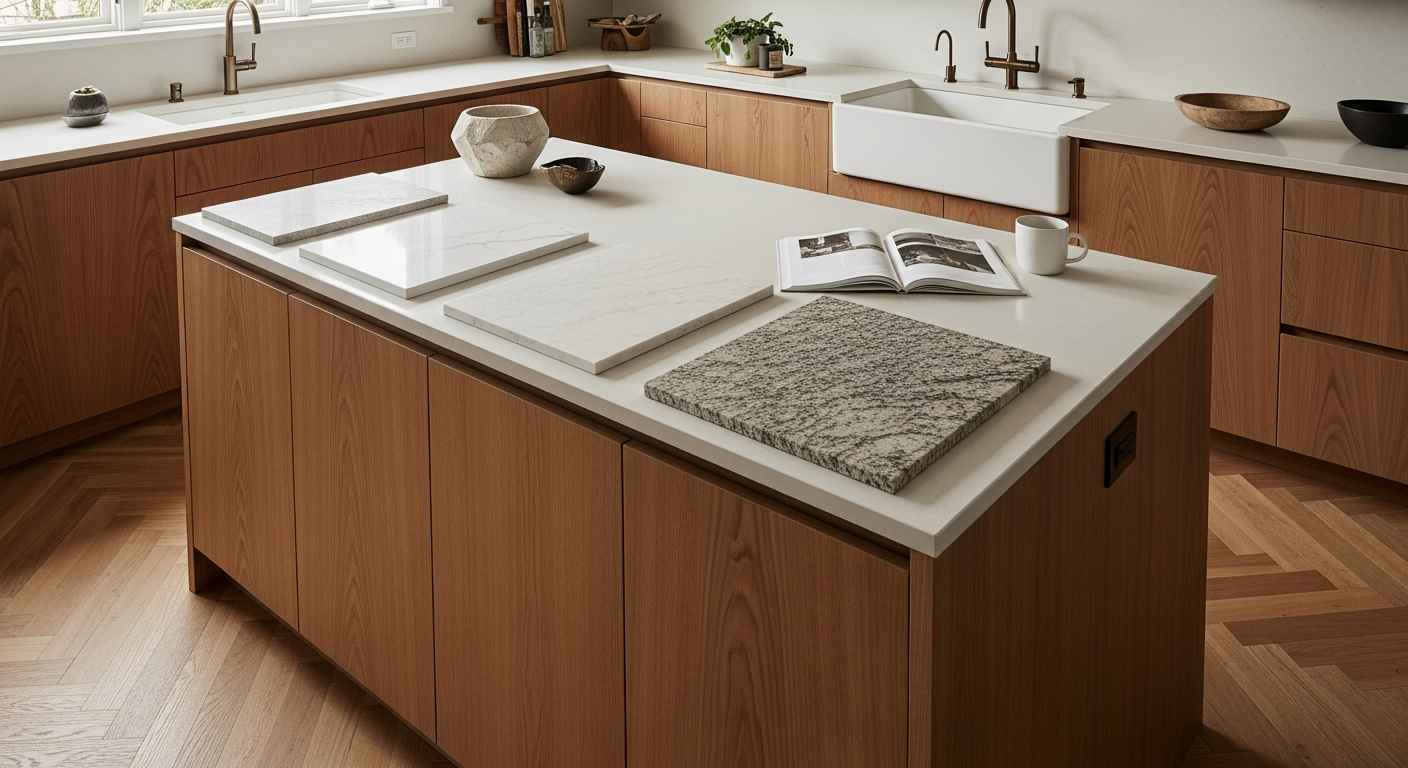
Quartz is engineered, quartzite is metamorphic natural stone, and granite is igneous natural stone — and confusing them is one of the most common mistakes I see Bay Area homeowners make when planning a kitchen remodel. Despite their similar-sounding names, these three countertop materials differ dramatically in composition, performance, maintenance, and price. Choosing the wrong one can mean thousands of dollars wasted and years of frustration.
Here's a quick breakdown of what each material actually is:
- Quartz countertops (also called engineered quartz) are manufactured slabs made from roughly 90–94% ground natural quartz crystals bound together with polymer resins, pigments, and sometimes recycled materials. Popular brands include Caesarstone, Cambria, Silestone, and MSI. Because they're manufactured, they come in highly consistent colors and patterns — including convincing marble lookalikes.
- Quartzite countertops are 100% natural stone, formed when sandstone is subjected to extreme heat and pressure deep within the earth. The result is one of the hardest natural stones available — harder than granite. Quartzite slabs like Taj Mahal, Sea Pearl, and Calacatta Viola quartzite offer the soft, veined aesthetic of marble with significantly better durability.
- Granite countertops are also natural stone, formed from cooled magma. Granite contains a mix of feldspar, quartz, mica, and other minerals, which gives each slab its unique speckled or swirled pattern. Granite has been a kitchen staple for decades and remains a strong choice in 2026, though it's evolved far beyond the "builder-grade" look of the 2000s.
As someone who's completed over 116 remodels across the Bay Area, the single biggest mistake I see homeowners make is assuming quartz and quartzite are the same material. They are not — and that misunderstanding leads to wrong expectations about sealing, heat resistance, and long-term care. Let me walk you through every detail so you can make the right decision for your Los Gatos, Saratoga, or Palo Alto kitchen.
How Much Do Quartz, Quartzite, and Granite Countertops Cost in the Bay Area in 2026?
Bay Area countertop costs in 2026 range from $65 to $250+ per square foot installed, depending on the material, slab grade, edge profile, and complexity of the layout. Based on our 2026 project data from 116+ completed kitchens across Silicon Valley, here's what homeowners should budget for countertops alone (material + fabrication + installation):
| Material | Cost per Sq Ft (Installed) | Average 40 Sq Ft Kitchen Island | Full Kitchen (60–80 Sq Ft) |
|---|---|---|---|
| Quartz (mid-range: Caesarstone, Silestone) | $75–$135 | $3,000–$5,400 | $4,500–$10,800 |
| Quartz (premium: Cambria, Dekton) | $110–$175 | $4,400–$7,000 | $6,600–$14,000 |
| Quartzite (mid-range: White Macaubas, Fantasy Brown) | $100–$160 | $4,000–$6,400 | $6,000–$12,800 |
| Quartzite (premium: Taj Mahal, Calacatta Viola) | $150–$250+ | $6,000–$10,000+ | $9,000–$20,000+ |
| Granite (mid-range: Ubatuba, New Venetian Gold) | $65–$110 | $2,600–$4,400 | $3,900–$8,800 |
| Granite (premium: Blue Bahia, Patagonia) | $120–$200 | $4,800–$8,000 | $7,200–$16,000 |
A few important notes about Bay Area pricing in 2026:
- Fabrication and installation labor runs 20–35% higher in the Bay Area compared to national averages. Skilled stone fabricators in Santa Clara County and San Mateo County charge a premium — and they're worth it. A poor templating job can ruin a $15,000 slab.
- Slab selection trips matter. I always recommend that our clients visit Bay Area stone yards in person. The difference between a $90/sq ft Caesarstone and a $180/sq ft Calacatta Viola quartzite slab isn't just price — it's the entire character of your kitchen. We typically schedule slab selections at yards in San Jose and South San Francisco.
- Dekton by Cosentino deserves a separate mention. Technically an ultra-compact surface (not quartz), Dekton Kreta and Dekton Arga have become hugely popular in our 2026 Los Altos and Menlo Park projects for their UV resistance, extreme heat tolerance, and massive slab sizes that minimize seams. Expect $130–$185 per square foot installed.
For a mid-range kitchen remodel in Los Gatos, countertops typically represent 12–18% of the total project budget. A full gut kitchen remodel in the Bay Area costs between $85,000 and $200,000+ in 2026 according to our project data, so countertop selection is one of the highest-impact decisions you'll make.
Durability and Maintenance: Which Countertop Holds Up Best in a Busy Kitchen?
Quartzite is the most scratch-resistant, quartz is the lowest maintenance, and granite falls in between — each material has genuine strengths and trade-offs that matter for daily kitchen use. Here's what I tell every homeowner who asks me which countertop is the most durable:
Quartz: Virtually Maintenance-Free
Engineered quartz is non-porous, meaning it never needs sealing and resists staining from wine, coffee, and cooking oils. For families with young kids or anyone who doesn't want to think about countertop care, quartz is hard to beat. The resin binders make it slightly softer than quartzite (registering 6–7 on the Mohs hardness scale), which means it's possible to scratch if you drag a cast-iron pan across it, but it's extremely resilient in normal use.
The one genuine weakness: heat sensitivity. The polymer resins in quartz can discolor, crack, or develop dull spots when exposed to temperatures above 300°F. Hot pots and pans directly from the stove or oven can cause permanent damage. With induction cooktops becoming standard in our 2026 Silicon Valley remodels (roughly 65% of our clients now choose induction), I always advise quartz owners to use trivets religiously.
Quartzite: The Toughest Natural Stone
True quartzite rates 7–8 on the Mohs hardness scale, making it harder than granite and most knife blades. It handles heat beautifully — you can set a 500°F pot directly on quartzite without worry. It's also highly UV-resistant, making it an excellent choice for kitchens with large windows or indoor-outdoor layouts, which are incredibly popular in our Cupertino and Saratoga projects.
The trade-off is maintenance. Quartzite is a natural stone and, while denser than marble, it's still somewhat porous. It requires sealing once or twice per year depending on the specific variety. Taj Mahal quartzite is relatively low-porosity; Calacatta Viola quartzite may need more frequent attention. Our team always applies an initial high-performance penetrating sealer at installation and provides care instructions for every natural stone project.
Granite: Tried and True
Granite rates 6–7 on the Mohs hardness scale and handles heat almost as well as quartzite. It's been a kitchen workhorse for good reason. Granite requires sealing once per year (a 15-minute DIY task), and darker granites like Absolute Black are practically stain-proof even without sealing.
Here's a durability comparison based on what we see in our completed projects:
| Property | Quartz (Engineered) | Quartzite (Natural) | Granite (Natural) |
|---|---|---|---|
| Hardness (Mohs Scale) | 6–7 | 7–8 | 6–7 |
| Heat Resistance | Low — can crack/discolor above 300°F | Excellent — withstands 500°F+ | Very Good — withstands 450°F+ |
| Scratch Resistance | Good | Excellent | Good |
| Stain Resistance | Excellent (non-porous) | Good (requires sealing) | Good (requires sealing) |
| UV Resistance | Low — can fade near windows | Excellent | Excellent |
| Sealing Required | Never | 1–2x per year | 1x per year |
| Chip Repair | Difficult — resin-based, hard to match | Moderate — natural stone repair | Moderate — natural stone repair |
One thing I've learned after 116+ projects: the "best" material is the one that matches your lifestyle, not the one with the highest spec sheet numbers. A busy household with three kids under 10 and no interest in annual sealing? Quartz wins. An avid home chef who places hot pans on the counter constantly? Quartzite is the answer.
What Are the Best Countertop Materials for a 2026 Bay Area Kitchen Remodel?
In 2026, the most requested countertop materials in our Bay Area kitchen remodels are warm-toned quartzites, veined quartz that mimics natural stone, and Dekton ultra-compact surfaces — reflecting a broader design shift away from the cold, all-white kitchens of the 2010s toward organic warmth and natural textures.
Here's what our team at Barcci Builders is seeing across our 2026 projects in Los Gatos, Saratoga, Los Altos, Palo Alto, and Menlo Park:
Trending Countertop Choices in 2026
- Calacatta Viola quartzite — the purple-veined stunner that's replaced Calacatta marble as the aspirational countertop choice. Pairs beautifully with rift-cut white oak cabinetry and unlacquered brass hardware, both of which are dominant 2026 trends in Silicon Valley homes.
- Taj Mahal quartzite — soft gold and cream veining on a warm white base. This remains the most popular quartzite we install. It works in both transitional and contemporary kitchens, and its subtle warmth complements the move toward earthy, organic-toned kitchens.
- Cambria Brittanicca — the most convincing marble-look quartz on the market in 2026. High movement, dramatic veining, zero maintenance. We install this frequently in Campbell and San Jose kitchens where families want the marble aesthetic without the worry.
- Dekton Kreta and Dekton Arga — ultra-compact surfaces that resist everything: heat, UV, scratching, staining. We're specifying Dekton for waterfall islands and outdoor kitchens increasingly in 2026. It comes in massive slab sizes (up to 126" x 56") that allow seamless waterfall edges.
- Leathered granite — textured, honed granite finishes are making a strong comeback. A leathered Absolute Black or Titanium granite counter adds a tactile, organic quality that pairs perfectly with plaster range hoods, zellige tile backsplashes, and the hand-crafted aesthetic dominating 2026 design.
What's Falling Out of Favor
- Polished pure-white quartz — the Ikea-kitchen look of 2015–2020 is definitively over in the luxury market. Our clients are choosing slabs with movement, warmth, and natural variation.
- Basic "builder-grade" granite — speckled browns and uniform patterns from the 2005 era are being replaced, not with more granite, but with quartz or quartzite that offers a cleaner, more curated look.
- Marble for high-use areas — Calacatta marble is still gorgeous for a bathroom vanity or a bar area, but for primary kitchen countertops in a household that actually cooks, most of our 2026 Bay Area clients are choosing quartzite instead for the marble look with real durability.
One of the biggest trends I'm excited about: mixed-material kitchens. About 30% of our 2026 projects use one material for the perimeter countertops and a contrasting statement slab for the island. For example, honed Dekton on the perimeter and a bookmatched Taj Mahal quartzite waterfall island. It creates visual hierarchy and lets you feature a "hero slab" without the cost of surfacing the entire kitchen in premium quartzite. Our 3D design rendering service is invaluable for visualizing these material pairings before committing.
How Long Does a Kitchen Countertop Installation Take in the Bay Area?
Countertop fabrication and installation typically takes 2–4 weeks from template to completion in the Bay Area — but that timeline sits within a much larger remodeling schedule. Based on our 2026 project data, here's the full countertop timeline broken down:
- Slab selection: 1–3 days. We take clients to stone yards where you hand-pick your exact slab. This is especially important for natural stones like quartzite and granite where every slab is unique.
- Templating: 1 day. After cabinetry is fully installed, a fabricator creates a precise digital template of your countertop layout, including cutouts for sinks, cooktops, and faucets.
- Fabrication: 7–14 business days. The slab is cut, polished, edged, and finished at the fabrication shop. Complex edge profiles (mitered waterfall edges, for example) add time.
- Installation: 1–2 days. Slabs are transported and set with precision. Seams are filled with color-matched epoxy. Plumbing reconnection typically happens the same day or next day.
The total kitchen remodel timeline — from demolition to final walkthrough — averages 10–16 weeks for a full gut renovation in the Bay Area. Countertop installation happens toward the end, typically in weeks 8–12. Permit approval in Santa Clara County currently takes 4–8 weeks, so we always advise clients to start the planning process early.
One important caveat: exotic quartzite and imported stone slabs can extend your timeline. We've had situations where a client fell in love with a specific Calacatta Viola quartzite slab that needed to be sourced from a single distributor in Miami. That added two weeks to the project. When possible, we recommend selecting from local Bay Area stone yards to keep the schedule tight.
For homeowners considering a kitchen remodel alongside other work — perhaps a bathroom renovation or ADU addition — we typically coordinate countertop selections for multiple rooms simultaneously to streamline fabrication and reduce overall project time.
Should I Choose Quartz or Quartzite for a Kitchen Remodel in Los Gatos?
For most Los Gatos homeowners in 2026, quartzite offers the best combination of beauty, durability, and resale value — but quartz is the smarter choice if low maintenance is your top priority. There's no universally "right" answer, and after building kitchens across the Bay Area for years, I've seen both materials perform beautifully in the right context.
Here's my honest recommendation framework based on how our clients actually live:
Choose Quartz If:
- You want zero maintenance — no sealing, no special cleaners, ever
- You prefer a consistent, uniform appearance without natural variation
- You're working with a tighter countertop budget ($75–$135/sq ft installed)
- Your kitchen doesn't get heavy direct sunlight (quartz can fade with UV exposure)
- You don't regularly place extremely hot cookware directly on counters
- You have young children and want maximum stain resistance
Choose Quartzite If:
- You love the look of natural marble but need real durability
- You're an avid cook who places hot pots and pans on the counter
- Your kitchen has large windows or an indoor-outdoor connection
- You want a one-of-a-kind slab with natural movement and depth
- You're willing to seal the stone once or twice per year
- You're investing in a high-end remodel where countertops are the visual centerpiece
Choose Granite If:
- You want natural stone beauty at a lower price point
- You prefer a speckled, crystalline, or dramatic veined look (exotic granites)
- You're renovating a rental property or secondary kitchen where budget matters
- You want excellent heat and scratch resistance without the premium quartzite price
From a resale value perspective — which matters enormously in the Los Gatos and Monte Sereno real estate markets where median home prices exceed $3 million — all three materials are well-received by buyers. However, our 2026 project data shows that quartzite and premium quartz (Cambria, Dekton) are perceived as the most luxurious by Bay Area buyers. Standard granite, while practical, can read as dated in a luxury listing unless it's an exotic variety with a leathered or honed finish.
My advice: bring your top two or three slab options into the actual kitchen space during the design phase. We use our 3D rendering process to show clients exactly how a specific quartzite slab will look against their rift-cut white oak cabinets, zellige backsplash, and unlacquered brass Kohler faucet before a single dollar is spent on fabrication.
How to Avoid the Most Common Countertop Mistakes in a Bay Area Kitchen Remodel
The most expensive countertop mistakes happen before installation — during material selection and kitchen planning. After completing 116+ kitchen and whole-house remodels across the Bay Area, our team has identified the errors that cost homeowners the most money and frustration:
Mistake #1: Confusing Quartzite with Quartz (or Marble)
I cannot stress this enough. Some stone yards mislabel "soft quartzite" or "dolomite" as quartzite when it's actually calcite-based marble that will etch and stain. Before purchasing any quartzite slab, ask for a geological test or at minimum, try the vinegar test: if a drop of vinegar on the raw edge fizzes, it contains calcite and is not true quartzite. Our team verifies every natural stone slab before approving it for fabrication.
Mistake #2: Choosing a Countertop Based Solely on Small Samples
A 4" x 4" sample looks nothing like a full slab. Natural stones like Taj Mahal quartzite and exotic granites have dramatic variation from one end of the slab to the other. Always visit the stone yard and see the full slab in person. Some of our most beautiful kitchen installations — particularly in our Atherton and Woodside projects — feature bookmatched slabs where two halves of the same stone block create a mirror-image pattern on a waterfall island.
Mistake #3: Ignoring Edge Profiles and Seam Placement
The edge profile changes the entire look of your countertop. A mitered edge on a waterfall island creates a clean, monolithic look; a bullnose feels traditional; an eased edge is contemporary and minimal. Seam placement matters too — an experienced fabricator will locate seams at natural break points (like where the counter meets a stove cutout) to minimize visibility.
Mistake #4: Not Coordinating with Plumbing and Appliance Specs
Undermount sink cutouts, Thermador or Miele cooktop dimensions, Kohler faucet hole spacing — all of these must be confirmed before templating. We've seen homeowners change their sink selection after fabrication, requiring expensive re-cutting or entirely new slabs. At Barcci Builders, we finalize all fixture selections before the fabricator arrives for templating.
Mistake #5: Underestimating Total Installed Cost
The per-square-foot slab price is just the beginning. Fabrication, transportation, installation, cutouts, edge finishing, and the removal of old countertops all add up. In the Bay Area, expect the total installed cost to be 40–60% more than the raw slab price. Budget accordingly, and get a detailed written quote that breaks down every line item.
If you're planning a whole-house remodel that includes kitchen countertops, bathroom vanities, and possibly outdoor surfaces, selecting materials across all rooms simultaneously can yield volume discounts from fabricators — something our team coordinates as part of every project.
Frequently Asked Questions
Is quartzite more expensive than quartz countertops in the Bay Area?
Yes, quartzite generally costs more than quartz in the Bay Area. Based on our 2026 project data, mid-range quartz (Caesarstone, Silestone) runs $75–$135 per square foot installed, while mid-range quartzite starts at $100–$160 per square foot installed. Premium quartzite varieties like Taj Mahal and Calacatta Viola can reach $200–$250+ per square foot in the Bay Area due to the rarity of certain slabs and higher fabrication complexity. However, premium quartz brands like Cambria Brittanicca ($110–$175/sq ft installed) overlap significantly with mid-range quartzite pricing, so the gap narrows depending on your specific selections.
Can you put hot pots on quartzite countertops?
Yes, quartzite has excellent heat resistance and can withstand temperatures well above 500°F without damage. Unlike engineered quartz, which contains polymer resins that can discolor, crack, or develop dull burn marks above 300°F, quartzite is 100% natural stone and handles direct heat from pots, pans, and baking sheets without issue. That said, we still recommend using trivets as a best practice to protect any sealant applied to the surface. In our 116+ Bay Area kitchen projects, we've never seen a quartzite countertop damaged by heat from normal cooking use.
How much does a kitchen countertop replacement cost in Los Gatos in 2026?
A full kitchen countertop replacement in Los Gatos costs between $4,500 and $20,000+ in 2026, depending on the material, total square footage, and complexity of the layout. For a typical Los Gatos kitchen with 60–80 square feet of countertop surface, mid-range quartz runs $4,500–$10,800 installed, mid-range quartzite costs $6,000–$12,800, and mid-range granite costs $3,900–$8,800. Premium materials like bookmatched Calacatta Viola quartzite with a mitered waterfall island can push the total above $20,000. These prices include fabrication, installation, sink cutouts, and edge profiles based on our 2026 Bay Area project data.
Does quartzite need to be sealed every year?
Most quartzite countertops need sealing once or twice per year to maintain optimal stain resistance. The frequency depends on the specific quartzite variety — denser stones like Taj Mahal require less frequent sealing than more porous varieties. At Barcci Builders, we apply a high-performance penetrating sealer (such as Tenax Proseal or Stonetech BulletProof) at installation, which typically provides 6–12 months of protection. Annual resealing is a simple 15-minute DIY process: clean the surface, apply the sealer with a cloth, let it absorb for 10 minutes, and wipe the excess. If you water-test the surface (place a few drops of water; if it absorbs within 5 minutes instead of beading, it's time to reseal), you can stay ahead of any issues.
What is the best countertop material for resale value in Silicon Valley?
In the Silicon Valley luxury real estate market in 2026, quartzite and premium quartz (Cambria, Dekton) offer the strongest countertop resale value. Our project data shows that kitchens featuring quartzite — particularly Taj Mahal or Calacatta Viola — photograph exceptionally well for listings and are consistently highlighted by real estate agents as premium features. Quartz is also well-received, especially when paired with current design trends like rift-cut white oak cabinetry and integrated appliances. Standard granite, while practical, can read as dated in the $2M+ Bay Area market unless it's an exotic variety with a leathered or honed finish. The key is that the countertop should feel intentional and design-cohesive, not like an afterthought.
Quartz vs granite countertops: which is better for families with kids?
For families with children, quartz is generally the better choice over granite due to its non-porous surface that never requires sealing. Spills from juice, pasta sauce, and markers wipe right up without staining. Quartz also has no natural fissures or pits where bacteria could harbor, making it one of the most hygienic countertop surfaces available. Granite is also a strong family-friendly option — it's durable, heat-resistant, and affordable — but it does require annual sealing and can stain if red wine or acidic liquids sit on the surface for extended periods. In our Bay Area projects, roughly 78% of families with children under 12 choose quartz over granite in 2026, primarily for the maintenance-free convenience.
How long does it take to install new countertops during a kitchen remodel in the Bay Area?
The countertop process — from slab selection through completed installation — typically takes 2–4 weeks in the Bay Area. This breaks down to 1–3 days for slab selection, 1 day for digital templating (after cabinetry is installed), 7–14 business days for fabrication, and 1–2 days for installation. The total timeline for a full kitchen remodel, including countertops, averages 10–16 weeks from demolition to final walkthrough based on our 2026 project data. Permit approval in Santa Clara County currently takes 4–8 weeks, so we advise starting the planning process well before your desired construction start date. Exotic quartzite or imported stone slabs that need to be sourced from outside the Bay Area can add 1–2 additional weeks.
Is Dekton better than quartz for kitchen countertops?
Dekton offers superior heat resistance, UV resistance, and scratch resistance compared to quartz, but it costs more and has a more limited color palette. Dekton is an ultra-compact surface made by Cosentino using a process called TSP (Technology of Sintered Particles), which fuses raw materials at extreme temperatures. The result is a surface that won't burn, fade, or stain under virtually any condition. In our 2026 Bay Area projects, we're specifying Dekton increasingly for waterfall islands, outdoor kitchens, and kitchens with heavy sun exposure. Popular colors include Dekton Kreta (warm cream travertine look) and Dekton Arga (gray limestone aesthetic). At $130–$185 per square foot installed in the Bay Area, it's priced similarly to premium quartz and mid-range quartzite. The trade-off: Dekton has fewer color options than quartz brands like Cambria, and some homeowners find it lacks the natural depth of real stone.