How Much Does an Open Concept Kitchen Remodel Cost in Silicon Valley in 2026?
An open concept kitchen remodel in Silicon Valley typically costs between $85,000 and $250,000+ in 2026, depending on the scope of structural work, your material selections, and the complexity of mechanical relocations. Based on our data from 116+ completed Bay Area projects at Barcci Builders, the median investment for a full open-concept conversion — including load-bearing wall removal, kitchen redesign, and finishing — lands around $155,000 for a mid-to-upper-range project in cities like Los Gatos, Saratoga, and Palo Alto.
That number surprises some homeowners who assume opening up a wall is the simple part. In reality, the structural engineering, permit process, and rerouting of mechanical systems behind that wall account for a significant portion of the budget. Here's how the costs typically break down for a Silicon Valley open concept kitchen remodel:
| Cost Category | Typical Range (2026, Bay Area) | % of Total Budget |
|---|---|---|
| Structural engineering & wall removal | $8,000–$25,000 | 8–12% |
| Cabinetry (custom or semi-custom) | $18,000–$55,000 | 20–25% |
| Countertops (quartz, quartzite, marble) | $8,000–$28,000 | 8–12% |
| Appliances (mid-range to premium) | $12,000–$45,000 | 12–18% |
| Flooring (hardwood, LVP, tile) | $6,000–$18,000 | 5–8% |
| Electrical & lighting | $5,000–$15,000 | 5–8% |
| Plumbing relocations | $3,000–$12,000 | 3–6% |
| Permits & design | $4,000–$12,000 | 3–6% |
| Finishes, paint, trim & details | $5,000–$15,000 | 4–7% |
| General conditions & project management | $8,000–$20,000 | 8–10% |
A few important notes on these numbers. First, Bay Area labor rates are 20–35% higher than the national average. A licensed general contractor in Santa Clara County will carry higher insurance, bonding, and labor costs than contractors in most U.S. markets — and that's reflected in every line item. Second, material choices swing the budget dramatically: choosing Calacatta Viola marble over Caesarstone quartz for a 45-square-foot island can add $8,000–$12,000 alone. As someone who's built over 116 kitchens across Silicon Valley, I always tell clients to nail down their material tier before fixating on a total budget number.
Do You Need a Permit to Remove a Wall for an Open Kitchen in the Bay Area?
Yes — in virtually every Bay Area city, you need a building permit to remove a wall and create an open concept kitchen layout. If the wall is load-bearing (and in most single-story and two-story homes built before 1990, the wall between the kitchen and living room is load-bearing), you'll also need stamped structural engineering plans before the city will issue a permit. This is non-negotiable in Santa Clara County, San Mateo County, and every municipality our team works in.
Here's what the permit process looks like for a typical open concept kitchen remodel in Silicon Valley in 2026:
- Step 1: Structural assessment — A licensed structural engineer evaluates the wall, determines if it's load-bearing, and designs a beam-and-post system (typically an LVL or steel beam) to carry the load. Cost: $1,500–$4,000.
- Step 2: Architectural plans — Your designer or architect prepares a plan set showing demolition, the new structural support, updated electrical and plumbing layouts, and finish details. If you're working with a design-build contractor like Barcci Builders, this is handled in-house.
- Step 3: Permit submission — Plans are submitted to the local building department. In the Town of Los Gatos, permit review for a kitchen remodel with structural work currently takes 3–6 weeks. In San Jose, plan check can take 4–8 weeks depending on backlog. Cupertino and Palo Alto fall somewhere in between.
- Step 4: Inspections during construction — You'll typically need a framing/structural inspection (after the beam is installed), rough electrical, rough plumbing, insulation, and a final inspection.
Skipping permits is never worth the risk in Silicon Valley. Beyond the legal and safety issues, unpermitted structural work can derail a home sale — and in a market where homes in Los Altos and Menlo Park routinely sell for $3–$5 million, no buyer's inspector is going to overlook a missing beam permit. Our team handles the entire permit process for every project we take on, because it's that important.
One thing I've learned from 116+ completed projects: the permit timeline is the single biggest variable most homeowners underestimate. Budget 4–8 weeks just for approvals before any demolition begins. In cities like Cupertino and Mountain View, minor revisions requested by plan checkers can add another 2–3 weeks.
Open Concept Kitchen Design Trends in Silicon Valley for 2026
The open concept kitchen designs we're building in 2026 have evolved significantly from the all-white, shaker-cabinet aesthetic that dominated the Bay Area for the past decade. Today's Silicon Valley homeowners want warmth, texture, and natural materials — kitchens that feel like living spaces, not showrooms. Based on our 2026 project data at Barcci Builders, here are the trends defining the best open concept kitchens we're building right now:
Rift-Cut White Oak Cabinetry
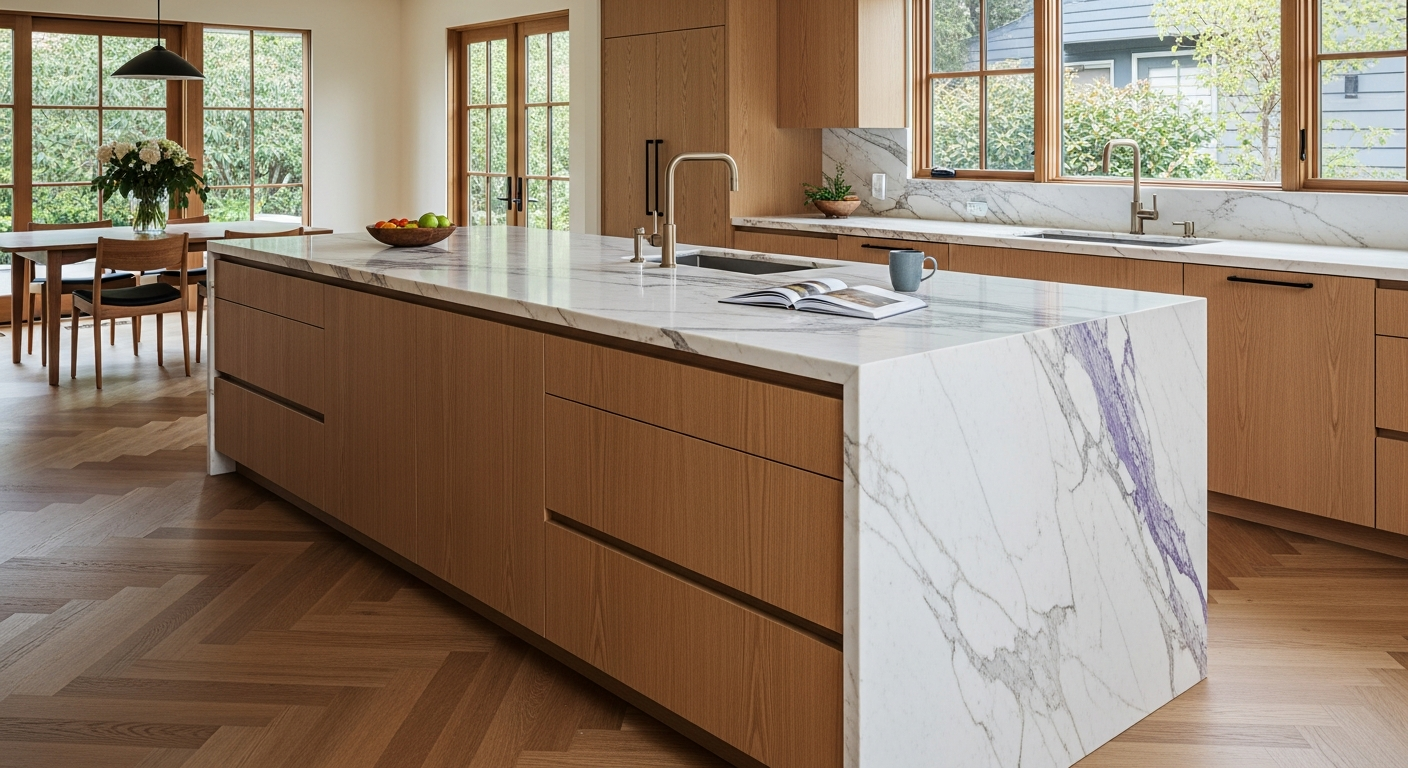
This is the single most requested material in our kitchen projects this year. Rift-cut white oak has a clean, linear grain that reads warm and modern without feeling rustic. We're using it in slab-style cabinet doors with integrated finger pulls (no visible hardware) for a seamless look that flows beautifully in an open floor plan. About 65% of our 2026 kitchen clients are choosing some form of white oak, either for full cabinetry or as a contrasting island material paired with painted perimeter cabinets in warm tones like greige, mushroom, or soft sage.
Statement Islands with Waterfall Edges
In an open concept layout, the kitchen island becomes the visual anchor of the entire living space. We're building 9-to-12-foot islands with Calacatta Viola marble, Dekton Kreta, and book-matched quartzite slabs featuring waterfall edges that cascade to the floor. These islands serve as prep space, casual dining, and a visual divider between the kitchen and living zones — without closing off sightlines.
Plaster Range Hoods and Fluted Details
Stainless steel range hoods are giving way to hand-applied plaster range hoods in organic, curved shapes that soften the kitchen visually — especially important in an open concept design where the hood is visible from the living room. We're also incorporating fluted details in island panels, pantry doors, and bar fronts. These vertical groove textures add depth and craftsmanship.
Warm Earthy Tones and Natural Stone
The sterile all-white kitchen is over in Silicon Valley. Our 2026 clients are gravitating toward warm earthy tones: taupe, clay, warm putty, and olive paired with natural stone veneer accents, zellige tile backsplashes, and unlacquered brass hardware and fixtures. These choices create a kitchen that feels lived-in and inviting from every angle of the open floor plan.
Induction Cooktops and Concealed Ventilation
About 70% of our 2026 Bay Area kitchen remodels include induction cooktops — brands like Miele, Thermador, andDERA. They're sleeker, safer, and faster than gas, and they eliminate the indoor air quality concerns that increasingly matter to Bay Area homeowners. In open concept layouts, we frequently pair induction with downdraft ventilation or ceiling-mounted recirculating hoods to keep the sightlines clean.
Herringbone Wood Floors as a Unifying Element
When you remove a wall, you need the flooring to flow seamlessly between the kitchen and living areas. Herringbone-pattern European white oak floors have become our go-to recommendation — they add visual interest underfoot without competing with the cabinetry, and they run beautifully across the combined space. We use engineered hardwood rated for kitchens and finished with a matte, low-VOC polyurethane.
How Long Does an Open Concept Kitchen Remodel Take in the Bay Area?
A full open concept kitchen remodel in the Bay Area takes 14–22 weeks from demolition to final walkthrough, based on our 2026 project data. Add 4–8 weeks of design and permitting on the front end, and you're looking at a total timeline of roughly 5–7 months from your first design meeting to cooking your first meal in the new space.
Here's how that timeline typically breaks down:
| Phase | Duration | Key Activities |
|---|---|---|
| Design & Engineering | 3–5 weeks | Space planning, 3D renderings, structural engineering, material selections |
| Permitting | 4–8 weeks | Plan submission, city review, revisions, permit issuance |
| Demolition & Structural | 1–2 weeks | Wall removal, beam installation, framing inspection |
| Rough Mechanical | 2–3 weeks | Electrical rerouting, plumbing relocation, HVAC adjustments |
| Drywall & Finish Prep | 1–2 weeks | Drywall, taping, mudding, texture matching |
| Cabinetry Installation | 1–2 weeks | Cabinet delivery and install, scribe fitting |
| Countertop Fabrication & Install | 2–3 weeks | Template after cabinets, fabrication, installation |
| Tile, Backsplash & Flooring | 1–2 weeks | Zellige tile, hardwood transition work, grout and seal |
| Fixtures, Appliances & Punch List | 1–2 weeks | Appliance install, fixture trim-out, final details, cleaning |
The two biggest timeline risks in 2026? Custom cabinetry lead times (currently 6–10 weeks for most Bay Area cabinet shops, and 12–16 weeks for imported European systems) and specialty countertop material availability. Calacatta Viola marble and exotic quartzites sometimes require 4–6 weeks from slab yard selection to templating availability. We mitigate this by selecting and reserving slabs during the design phase, before permits are even submitted.
As someone who's managed the timelines on over 116 remodels, the single biggest piece of advice I can give: make all your material decisions before demolition day. Every "I'll figure it out later" turns into a one-to-two-week delay on a critical-path item. Our 3D design rendering process helps clients visualize the final space and commit to selections with confidence before we swing a hammer.
Open Concept Kitchen vs. Closed Kitchen: Which Is Better for Bay Area Homes?
For most Bay Area homes built between 1950 and 2000, converting to an open concept kitchen layout adds both livability and resale value — but it's not the right move for every home or every homeowner. After 116+ projects across Silicon Valley, I've seen both layouts work beautifully when designed with intention. Here's an honest comparison:
| Factor | Open Concept Kitchen | Closed/Traditional Kitchen |
|---|---|---|
| Resale appeal in Silicon Valley | Strong — buyers expect it in updated homes | Acceptable if kitchen itself is high-end |
| Entertaining & family life | Excellent — cook while engaging with guests and kids | More separation; cook in peace |
| Natural light flow | Significantly improved — light reaches deeper into the home | Limited to kitchen windows only |
| Noise management | Kitchen noise carries to living areas | Better noise isolation |
| Cooking smells | Require high-quality ventilation (especially without gas) | Naturally contained |
| Visual clutter | Kitchen must stay organized; always visible | Hidden behind walls and doors |
| Remodel cost | $85K–$250K+ (includes structural work) | $65K–$180K+ (no wall removal) |
| Permit complexity | Higher — structural engineering required | Lower — cosmetic remodels may not need structural permits |
In practice, most of our clients in Los Gatos, Saratoga, and Palo Alto choose open concept layouts because Bay Area homes — particularly ranch-style and mid-century homes — tend to have choppy floor plans with small, isolated kitchens that don't match how families actually live today. Opening the kitchen to the living and dining areas makes a 1,800-square-foot home feel like 2,400 square feet. The transformation is dramatic.
That said, I've talked clients out of open concept when the structural work would be disproportionately expensive (multiple load-bearing walls, a chimney in the way, second-floor plumbing directly above) or when the existing kitchen footprint was already generous. A closed kitchen with a large pass-through or wide cased opening can deliver 80% of the open-concept feel at 50% of the structural cost.
What to Know Before Starting an Open Concept Kitchen Remodel in Los Gatos and the Bay Area
Before you commit to an open concept kitchen remodel, there are five critical factors Bay Area homeowners need to evaluate — and most of them have nothing to do with countertop colors or cabinet styles.
1. Determine If Your Wall Is Load-Bearing
This is the first question that will determine your budget, timeline, and engineering requirements. In most Bay Area homes — especially single-story ranches in Campbell, split-levels in the West San Jose hills, and two-story colonials in Willow Glen — the wall between the kitchen and the living room carries structural load. Removing it requires an engineered beam (steel or LVL), new posts or columns, and potentially foundation upgrades to handle the point loads. A structural engineer assessment ($1,500–$4,000) is always the first step.
2. Budget for What's Inside the Wall
That wall you want to remove probably isn't empty. Our team routinely finds electrical wiring (including the main kitchen circuit runs), plumbing supply and drain lines (especially if there's a bathroom above), HVAC ductwork, and sometimes even gas lines routed through the wall. Rerouting these mechanical systems can add $5,000–$15,000 to the project, and this cost is frequently underestimated by homeowners who've been quoted "just the wall removal" by inexperienced contractors.
3. Plan for Flooring Continuity
When you remove a wall, you expose the floor beneath it — and in most cases, the flooring in the kitchen doesn't match the flooring in the living room. Budget for new flooring across the entire combined space. Trying to patch mismatched floors is one of the most visible shortcuts in any open concept remodel, and it cheapens the result. In 2026, we recommend engineered European white oak in a herringbone or wide-plank pattern throughout the open area.
4. Think About Lighting Zones
A combined kitchen-living space needs layered lighting that lets you set different moods in different zones. We typically install dedicated circuits for kitchen task lighting (under-cabinet LEDs), pendant lighting over the island, ambient cove lighting, and separate living room lighting — all on dimmers. This is planned during the rough electrical phase and is much harder to add after drywall.
5. Choose a Design-Build Contractor
An open concept kitchen remodel involves architecture, structural engineering, design, and construction — all tightly coordinated. A design-build firm manages all of these under one contract, which eliminates the finger-pointing between separate architects, engineers, and builders that causes delays and budget overruns. Our team at Barcci Builders (CA License #1086047) handles every phase from initial 3D design rendering through final walkthrough.
How to Maximize ROI on an Open Concept Kitchen Remodel in Silicon Valley
Open concept kitchen remodels in Silicon Valley recoup 60–80% of their cost at resale, according to our analysis of Bay Area comparable sales data for homes we've renovated. That ROI outperforms most other renovation categories in the South Bay and Peninsula markets — but only when the project is executed at the right quality level for the neighborhood.
Here's how to maximize your return:
- Match the investment to the home's value tier. In a $1.5M Campbell ranch, a $95,000 open concept kitchen remodel is the sweet spot. In a $3.5M Los Gatos estate, you can justify $175,000–$250,000 and still see strong returns. Over-improving for the neighborhood is the fastest way to lose money.
- Invest in the island. In an open floor plan, the island is the centerpiece that buyers notice first. A stunning slab of Calacatta Viola marble or book-matched Dekton on a 10-foot island with waterfall edges, integrated seating, and concealed storage will drive more perceived value than almost any other single element.
- Don't cheap out on appliances. Silicon Valley buyers expect premium appliances. A Thermador or Miele package (refrigerator, range or cooktop, dishwasher, and hood) signals quality. 78% of our Bay Area clients in 2026 are choosing these brands. Commodity appliances in a high-end kitchen are a mismatch that savvy buyers will notice immediately.
- Choose timeless over trendy. The warm, natural material palette trending in 2026 — rift-cut white oak, natural stone, unlacquered brass — has longevity because it's rooted in craft and materiality rather than a specific color fad. Avoid overly niche choices that might date the kitchen in 3–5 years.
- Get the permit. Permitted, inspected structural work is an asset. Unpermitted wall removal is a liability. In Silicon Valley's disclosure-heavy real estate market, this matters enormously.
As someone who's completed over 116 remodels across the Bay Area, the single biggest ROI mistake I see homeowners make is spending $200,000 on a kitchen remodel but skipping the professional design phase. A $5,000 investment in proper space planning and 3D visualization prevents $30,000 in regrettable decisions. Every. Single. Time.
Frequently Asked Questions
How much does it cost to remove a wall and open up a kitchen in the Bay Area?
Removing a load-bearing wall and opening up a kitchen in the Bay Area costs between $8,000 and $25,000 for the structural work alone (engineering, beam, posts, and associated framing) in 2026. However, the total cost of a full open concept kitchen remodel — including the new kitchen design, cabinetry, countertops, appliances, flooring, and finishes — ranges from $85,000 to $250,000+ in Silicon Valley. The structural wall removal typically represents 8–12% of the total project budget. Based on our data from 116+ completed Bay Area projects at Barcci Builders, the median total project cost is approximately $155,000.
Do I need a permit to knock down a wall between my kitchen and living room in San Jose?
Yes, you need a building permit to remove any wall in San Jose — and if the wall is load-bearing (which most walls between kitchens and living rooms are), you also need stamped structural engineering plans. The San Jose Department of Planning, Building and Code Enforcement requires a plan set showing the existing conditions, proposed demolition, new structural support (beam and post design), and updated electrical and plumbing layouts. Plan check currently takes 4–8 weeks in San Jose as of 2026. Skipping the permit can result in fines, forced restoration of the wall, and serious complications when you sell your home.
How long does an open concept kitchen remodel take from start to finish?
An open concept kitchen remodel in the Bay Area takes approximately 5–7 months total from your first design meeting to the final walkthrough. This breaks down to 3–5 weeks for design and engineering, 4–8 weeks for permitting (varies by city — Los Gatos is typically faster than San Jose), and 14–22 weeks for construction. Based on our 2026 project data at Barcci Builders, the average construction duration for an open concept kitchen conversion is 16 weeks. The two biggest timeline variables are custom cabinetry lead times (6–16 weeks depending on the manufacturer) and permit review timelines in your specific city.
Is an open concept kitchen a good idea for resale value in Silicon Valley?
Yes — open concept kitchen remodels are one of the highest-ROI renovations in Silicon Valley's housing market. Based on our analysis of Bay Area comparable sales, open concept kitchen remodels recoup 60–80% of their cost at resale, and in many cases, they help homes sell faster by meeting buyer expectations for modern, updated living spaces. Bay Area buyers in 2026 — particularly in cities like Los Gatos, Palo Alto, Los Altos, and Saratoga — overwhelmingly prefer open floor plans. A home with a closed-off, dated kitchen in a competitive market will sell for less and sit longer than a comparable home with an open, updated kitchen.
What is the best countertop material for an open concept kitchen in 2026?
The most popular countertop materials for open concept kitchens in the Bay Area in 2026 are quartzite, Dekton (a sintered stone by Cosentino), and natural marble — particularly Calacatta Viola and Calacatta Borghini for statement islands. Based on our project data, 78% of our Bay Area clients choose quartz or quartzite over granite. For islands visible from the living room, we recommend a dramatic natural stone or Dekton Kreta slab with a waterfall edge, which serves as the visual centerpiece of the open floor plan. For perimeter counters that see heavy daily use, engineered quartz from brands like Caesarstone or Cambria offers excellent durability with lower maintenance than natural stone.
How much does a kitchen island cost for an open concept layout in the Bay Area?
A custom kitchen island for an open concept layout in the Bay Area costs between $12,000 and $45,000 in 2026, depending on size, material, and features. A basic 8-foot island with quartz countertops, painted cabinetry, and standard seating runs $12,000–$18,000. A 10-to-12-foot statement island with Calacatta Viola marble waterfall edges, rift-cut white oak base cabinetry, integrated finger pulls, built-in outlets, and a prep sink costs $25,000–$45,000. At Barcci Builders, we consider the island the most important design element in any open concept kitchen — it's the first thing you see, and it sets the tone for the entire space.
Can I convert my closed kitchen to open concept if I have a load-bearing wall?
Absolutely — the vast majority of open concept kitchen conversions involve removing a load-bearing wall. The wall is replaced by an engineered beam (typically a laminated veneer lumber beam or a steel I-beam) that transfers the load to posts or columns at each end. These posts can often be concealed inside adjacent walls or designed as architectural columns. A licensed structural engineer designs the beam system, the plans are permitted through your local building department, and the work is inspected at the framing stage. At Barcci Builders, roughly 85% of our open concept kitchen projects in Silicon Valley involve load-bearing wall removal — it's standard, well-understood work when handled by an experienced design-build contractor.
What are the most popular open concept kitchen design trends in the Bay Area for 2026?
The top open concept kitchen design trends in the Bay Area for 2026 include: rift-cut white oak cabinetry with integrated finger pulls (no visible hardware), hand-applied plaster range hoods in organic curved shapes, Calacatta Viola marble and Dekton Kreta waterfall island countertops, fluted cabinet panels and island details, zellige tile backsplashes, unlacquered brass fixtures and hardware, induction cooktops (Miele, Thermador), herringbone-pattern European white oak flooring, warm earthy color palettes (taupe, clay, sage, mushroom) replacing the all-white kitchen aesthetic, and ceiling-height cabinetry that maximizes storage while making 9-foot ceilings feel even taller. Based on our 2026 projects at Barcci Builders, the overarching theme is warmth and natural materiality.
Should I hire a design-build contractor or separate architect and builder for my open concept kitchen remodel?
For an open concept kitchen remodel, a design-build contractor is almost always the better choice. This type of project requires tight coordination between structural engineering, architectural design, and construction sequencing — and when those disciplines are managed by separate firms, miscommunication causes delays, change orders, and budget overruns. A design-build firm like Barcci Builders (CA License #1086047) manages the entire process under one contract: initial design, 3D renderings, structural engineering coordination, permitting, and construction. Based on our experience with 116+ Bay Area projects, the design-build approach typically saves clients 10–15% compared to the traditional architect-then-bid-to-builders model, and projects complete 3–6 weeks faster.