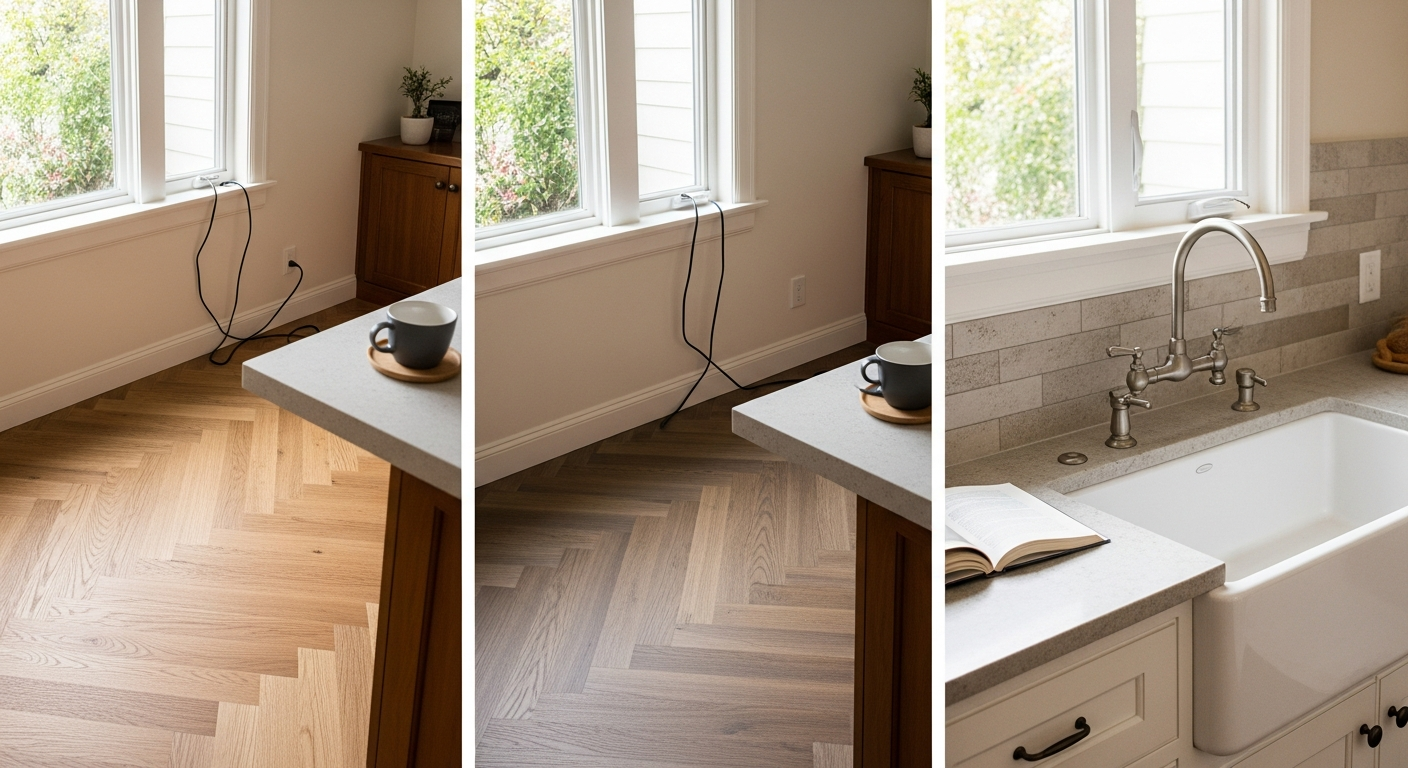
Hardwood vs LVP vs Tile: Which Flooring Is Best for Bay Area Homes?
Hardwood, LVP (luxury vinyl plank), and tile are the three most popular flooring options for Bay Area homeowners in 2026 — and each one excels in different situations. Hardwood delivers unmatched warmth and resale value, LVP offers waterproof durability at a lower price point, and tile provides the best performance in wet areas and high-heat zones. The "best" choice depends on your room, your budget, and how long you plan to stay in your home.
I'm Bar Benbenisty, founder of Barcci Builders (CA Contractor License #1086047), and over our 116+ completed projects across Los Gatos, Saratoga, Palo Alto, and the broader Silicon Valley, I've installed every flooring material on the market. Here's what I tell every homeowner who asks me the hardwood vs LVP vs tile question: there is no single winner. Each material has a role, and the smartest Bay Area remodels often use two or even all three throughout the home.
In this guide, I'll break down real 2026 Bay Area flooring costs per square foot, durability, maintenance, design trends, resale impact, and the specific scenarios where each material outperforms the others. Whether you're planning a whole-house remodel in Los Gatos or updating the kitchen in your Cupertino ranch home, this comparison will help you make a decision you'll be happy with for decades.
How Much Does Flooring Cost Per Square Foot in the Bay Area in 2026?
Bay Area flooring costs range from $6 to $28+ per square foot installed in 2026, depending on the material, subfloor preparation, and complexity of the layout. Based on our 2026 project data from 116+ completed Bay Area remodels, here are the real numbers we see — not national averages, but what homeowners in Silicon Valley are actually paying.
| Flooring Type | Material Cost (per sq ft) | Installed Cost (per sq ft) | 1,000 sq ft Total (Installed) | Lifespan |
|---|---|---|---|---|
| Solid Hardwood (white oak, walnut) | $8–$16 | $14–$28+ | $14,000–$28,000+ | 50–100+ years (refinishable) |
| Engineered Hardwood (rift-cut white oak) | $7–$14 | $12–$24 | $12,000–$24,000 | 25–50 years (limited refinish) |
| Luxury Vinyl Plank (LVP/SPC core) | $3–$8 | $6–$14 | $6,000–$14,000 | 15–25 years (not refinishable) |
| Porcelain Tile (large format) | $5–$18 | $12–$26 | $12,000–$26,000 | 50–75+ years |
| Natural Stone Tile (marble, limestone) | $12–$40+ | $18–$45+ | $18,000–$45,000+ | Lifetime (with maintenance) |
| Zellige / Handmade Tile | $15–$35 | $22–$42 | $22,000–$42,000 | 50+ years |
A few critical notes about Bay Area pricing. Labor rates in Santa Clara County and San Mateo County run 25–40% higher than the national average because of the cost of living, licensing requirements, and permitting complexity. When you see a home improvement site quoting $4/sq ft for LVP installation, that's not what happens in Los Gatos or Menlo Park. Our 2026 project data shows that even basic LVP installation in the South Bay starts at $6/sq ft installed when you factor in subfloor preparation, transitions, and proper undercut door casings.
For homeowners planning a kitchen remodel or bathroom renovation, flooring typically represents 8–15% of your total project budget. In a $150,000 kitchen remodel, expect to allocate $12,000–$22,000 for flooring — and that's for the kitchen alone.
Is Hardwood Flooring Worth It in Silicon Valley? Resale Value and Durability
Yes — hardwood flooring remains the highest-ROI flooring choice for Silicon Valley homes in 2026. According to the National Association of Realtors and corroborated by our experience with Bay Area real estate agents, homes with hardwood floors sell for 3–5% more than comparable homes with other flooring types. On a $2.5 million Los Gatos home, that's $75,000–$125,000 in additional perceived value.
Here's why hardwood dominates in our market:
- Bay Area buyers expect it. In neighborhoods like Professorville in Palo Alto, Old Town Los Gatos, and the Saratoga hills, hardwood flooring is essentially the baseline. LVP in a $3M+ home is immediately noticed — and not in a good way.
- It can be refinished 3–5 times. Solid hardwood (¾" thick) can be sanded and refinished multiple times over its 50–100+ year lifespan, meaning you can update the stain color to match evolving design trends without replacing the floor.
- It ages beautifully. Unlike LVP, which can look worn and dated after 15 years, well-maintained hardwood develops character and patina that actually adds to a home's appeal.
The 2026 hardwood trend I'm seeing across our Bay Area projects is overwhelmingly rift-cut white oak in a matte, natural or light warm finish. Gone are the dark espresso stains and high-gloss finishes of the 2010s. Today's Silicon Valley homeowners want wide-plank boards (6"–8" widths) with a European oil finish or low-sheen water-based polyurethane. Herringbone wood floor patterns are also surging in popularity — we installed herringbone white oak in four Saratoga projects in the past year alone.
The biggest drawback of hardwood? It's not waterproof. We never recommend solid hardwood in bathrooms, laundry rooms, or directly adjacent to pools. And in kitchens, while engineered hardwood performs well, homeowners with young children or heavy cooking habits should consider porcelain tile or a high-quality LVP for the kitchen zone. Hardwood also requires more careful climate control — the Bay Area's moderate humidity is actually ideal for hardwood, but homes with radiant floor heating need engineered hardwood (not solid) to prevent warping.
As someone who's completed over 116 remodels across the Bay Area, the single biggest mistake I see homeowners make is choosing a flooring material based on the lowest square-foot price instead of the total cost of ownership over 20+ years. Hardwood costs more upfront but lasts three to five times longer than LVP — and it can be refinished rather than ripped out and replaced.
LVP Flooring Pros and Cons: Is Luxury Vinyl Plank Good Enough for a Bay Area Home?
LVP (luxury vinyl plank) is a strong mid-range flooring option for Bay Area homes in 2026, particularly in basements, ADUs, rental units, laundry rooms, and budget-conscious whole-home remodels. However, it is not an equivalent substitute for real hardwood in high-end Silicon Valley homes — despite what some retailers claim.
Let me be direct: I recommend LVP often, but in the right contexts. Here's an honest breakdown.
LVP Pros
- 100% waterproof (SPC core). LVP with a stone polymer composite core handles water, spills, and pet accidents without damage. This makes it ideal for bathrooms, laundry rooms, and mudrooms where hardwood would fail.
- Lower cost. At $6–$14/sq ft installed in the Bay Area, LVP costs 40–60% less than hardwood for material and labor combined.
- Fast installation. LVP is a floating floor system — click-lock planks install over most existing subfloors in 1–2 days for an average room. This reduces labor costs significantly.
- Excellent scratch resistance. Families with large dogs or active kids find that LVP's wear layer outperforms hardwood for day-to-day scratch resistance.
- Huge design variety. Brands like COREtec, Mohawk RevWood, and Shaw Floorté offer convincing wood-look patterns. Some high-end LVP is genuinely difficult to distinguish from real wood at a casual glance.
LVP Cons
- Lower resale impact. In a competitive Bay Area market, LVP in main living areas can reduce perceived home value. Buyers in Palo Alto, Los Altos, and Atherton expect real hardwood.
- Cannot be refinished. Once the wear layer is through, the floor must be fully replaced. Most LVP has a functional lifespan of 15–25 years — compared to 50–100+ years for hardwood.
- Environmental concerns. LVP is a petroleum-based product. It is not biodegradable, difficult to recycle, and can off-gas VOCs, especially lower-cost imports. For eco-conscious Bay Area clients, this matters.
- Feels different underfoot. Even high-quality LVP has a slight plasticity — it doesn't have the resonance and warmth of real wood. On radiant heat systems, this difference becomes more noticeable.
- Susceptible to sun fading. In homes with large south-facing windows (common in Bay Area hillside properties), UV exposure can discolor LVP over time.
Our recommendation: use LVP strategically, not universally. It's excellent in an ADU or home addition where budget efficiency matters, in a basement conversion, or in a wet area where tile feels too cold. But for the main living areas of a $1.5M+ Bay Area home, hardwood almost always delivers better long-term value.
When Should You Choose Tile Flooring Over Hardwood or LVP?
Choose tile flooring when water resistance, heat resistance, or design longevity matters most — which in practice means bathrooms, kitchens, mudrooms, outdoor-indoor transitions, and any space with radiant floor heating. Tile is also the clear winner for homeowners who want a truly custom, architecturally distinct floor.
Tile is arguably the most versatile flooring option, and in 2026 it's having a major design moment in Bay Area homes. Here's when we specifically recommend it:
- Bathrooms: Porcelain tile remains the gold standard for every bathroom we build. Based on our 116+ completed projects, we estimate that 95%+ of Bay Area bathroom renovations use tile on both floors and walls. Large-format porcelain (24"×48" or 36"×36") in concrete-look or natural stone-look finishes dominates our 2026 bathroom projects in Menlo Park, Campbell, and Monte Sereno.
- Kitchens (high-use): For serious home cooks, families with young children, or anyone who wants a floor that can handle dropped cast iron, spilled wine, and daily mopping without worry, porcelain tile outperforms both hardwood and LVP.
- Radiant floor heating: Tile is the best conductor of radiant heat. It warms evenly and retains heat longer than hardwood or LVP. In our Saratoga and Los Gatos hillside projects, we pair hydronic radiant systems with large-format porcelain tile for exceptional comfort during cool Bay Area mornings.
- Indoor-outdoor living spaces: The Bay Area lifestyle revolves around blurring indoor and outdoor boundaries. Porcelain tile rated for exterior use (Dekton, outdoor-rated porcelain pavers) can create a seamless flow from kitchen to patio.
2026 Tile Trends in Bay Area Homes
The tile trends we're installing right now across Silicon Valley reflect a move toward warm, organic, handcrafted aesthetics:
- Zellige tile — handmade Moroccan tiles with irregular edges and a glossy, undulating surface. We're using these as kitchen backsplashes and bathroom feature walls across multiple Los Gatos and Saratoga projects.
- Dekton and ultra-compact surfaces — Dekton Kreta (a warm limestone look) and Dekton Eter are showing up as kitchen flooring and countertop-to-floor design statements.
- Large-format porcelain with book-matched veining — mimicking Calacatta Viola marble or Statuario marble without the maintenance demands of natural stone.
- Microcement / cementitious overlays — seamless, grout-free floors that create a modern, minimal aesthetic. Popular in Silicon Valley tech executive homes where a clean, gallery-like feel is desired.
- Natural stone (limestone, travertine) in tumbled or honed finishes for Mediterranean-inspired and organic modern homes.
| Feature | Hardwood | LVP | Porcelain Tile |
|---|---|---|---|
| Waterproof | No | Yes (SPC core) | Yes |
| Can Be Refinished | Yes (3–5 times) | No | No (but rarely needs it) |
| Lifespan | 50–100+ years | 15–25 years | 50–75+ years |
| Installed Cost (Bay Area) | $14–$28/sq ft | $6–$14/sq ft | $12–$26/sq ft |
| Resale Value Impact | Highest | Moderate | High (in wet areas) |
| Radiant Heat Compatible | Engineered only | Yes (limited temp) | Best option |
| Scratch Resistance | Moderate | High | Very High |
| Comfort Underfoot | Warm, natural | Moderate | Hard (warm with radiant) |
| Eco-Friendliness | High (renewable) | Low (petroleum-based) | Moderate to High |
| Best Rooms | Living, dining, bedrooms, hallways | Basements, ADUs, laundry, rentals | Bathrooms, kitchens, entryways, outdoor |
One important note on tile installation costs: tile labor in the Bay Area is among the most expensive in the country. A skilled tile setter in Santa Clara County charges $75–$120+ per hour in 2026. Large-format tiles, complex patterns (herringbone, chevron), and waterproofing systems (Schluter DITRA, Laticrete Hydro Ban) all add cost. Our 2026 project data shows that a high-quality tile bathroom floor with heated underlayment averages $22–$35/sq ft installed in the South Bay.
What Flooring Is Best for a Kitchen Remodel in the Bay Area?
For Bay Area kitchen remodels in 2026, our team most frequently recommends either engineered hardwood or large-format porcelain tile — the choice depends on your cooking habits, household composition, and aesthetic preference. LVP is a viable third option for budget-conscious renovations.
Here's how we guide our clients through this decision, based on our experience with kitchen-specific flooring across 116+ completed projects:
Engineered Hardwood in the Kitchen
About 55% of our 2026 Bay Area kitchen clients choose engineered rift-cut white oak. It creates a seamless flow from the living and dining areas into the kitchen — no awkward transitions, no threshold strips. Modern engineered hardwood with a UV-cured oil or matte polyurethane finish handles normal kitchen spills well, as long as you wipe them up within a reasonable timeframe. We recommend engineered over solid hardwood in kitchens because the plywood core is more dimensionally stable against moisture fluctuations.
Porcelain Tile in the Kitchen
About 35% of our kitchen clients choose large-format porcelain tile, especially families with young children, avid home cooks, and homeowners with connected indoor-outdoor kitchens. Porcelain handles dropped pots, spilled oil, standing water, and heavy foot traffic without flinching. Brands like Fiandre, Florim, and Atlas Concorde offer stunning wood-look, stone-look, and concrete-look porcelain that integrates beautifully with the warm earthy tones dominating Bay Area kitchen design in 2026.
LVP in the Kitchen
About 10% of our kitchen clients — typically those doing a cost-effective kitchen refresh or finishing an ADU — opt for LVP. It works, it's waterproof, and it's affordable. But I'll be honest: in a $120,000+ kitchen remodel in Los Gatos or Saratoga, LVP can undercut the quality impression of your new Thermador appliances and Calacatta Viola marble island. The floor sets the tone for the entire room.
If you're in the early planning stages of a kitchen renovation, our 3D design rendering service lets you see exactly how different flooring options look in your specific kitchen before committing to any material. This has saved our clients thousands of dollars in avoided regret.
Bay Area Flooring Installation: Timelines, Permits, and What to Expect
A typical Bay Area flooring installation takes 3–10 business days for an average-sized home (1,500–2,500 sq ft of flooring), not including subfloor preparation, which can add 2–5 days depending on conditions. Based on our 2026 project data, here are realistic timelines by material type.
| Flooring Type | Prep Time | Install Time (1,500 sq ft) | Total Timeline |
|---|---|---|---|
| Solid Hardwood (nail-down) | 2–4 days | 4–7 days | 6–11 days |
| Engineered Hardwood (glue or float) | 1–3 days | 3–5 days | 4–8 days |
| LVP (floating/click-lock) | 1–2 days | 2–4 days | 3–6 days |
| Porcelain Tile (mortar bed) | 2–4 days | 5–10 days | 7–14 days |
| Natural Stone Tile | 2–5 days | 7–12 days | 9–17 days |
A few Bay Area-specific considerations that affect your flooring project:
- Permits: Standalone flooring replacement generally does not require a building permit in Santa Clara County or San Mateo County. However, if your flooring project is part of a larger remodel that involves structural changes, electrical work, or plumbing relocation, permits are required. Permit approval in Santa Clara County currently takes 4–8 weeks for residential remodels.
- Asbestos testing: Many Bay Area homes built before 1980 — especially in Mountain View, Sunnyvale, and San Jose's Willow Glen neighborhood — have vinyl tile or mastic containing asbestos. California law requires testing before demolition. Abatement adds $3–$10/sq ft and 3–7 business days to your timeline.
- Subfloor condition: Older Bay Area homes frequently have uneven subfloors, moisture issues from crawl spaces, or outdated plywood that needs replacement. We always inspect and prepare the subfloor before quoting installation — cutting corners here leads to squeaking, buckling, and premature failure.
- Acclimation: Hardwood needs to acclimate to your home's humidity and temperature for 5–14 days before installation. LVP requires 48 hours. Tile has no acclimation requirement, which is one reason it installs on a more predictable schedule.
For a whole-house remodel that includes flooring, our team coordinates the flooring installation to happen after all rough-in work (plumbing, electrical, HVAC) and drywall finishing, but before final trim and cabinetry installation. This sequencing protects the new floors while allowing us to scribe trim and transitions perfectly — it's the kind of detail that separates a professional design-build approach from a piecemeal contractor experience.
Frequently Asked Questions
How much does it cost to install hardwood floors in a Bay Area home in 2026?
In 2026, hardwood floor installation in the Bay Area costs $14–$28+ per square foot fully installed, depending on the species, plank width, and pattern. Solid white oak in a standard straight-lay pattern runs $14–$20/sq ft installed, while rift-cut white oak in a herringbone pattern can reach $24–$28+/sq ft. For a typical 1,500 sq ft Bay Area home, expect a total investment of $21,000–$42,000+ for hardwood throughout the main living areas. Based on our 2026 project data at Barcci Builders, the most popular specification is 6"–8" wide rift-cut white oak planks with a matte water-based polyurethane or hardwax oil finish.
Is LVP flooring as good as hardwood for resale value?
No — LVP does not match hardwood's resale value impact, especially in high-value Bay Area markets. According to the National Association of Realtors, homes with real hardwood floors sell for 3–5% more than comparable homes without. In Silicon Valley, where median home prices exceed $1.5 million, that difference can represent $50,000–$100,000+ in perceived value. LVP is a smart choice for ADUs, basement conversions, and rental units where budget efficiency is the priority, but for main living areas in homes valued above $1.5M, real hardwood delivers significantly better ROI.
What is the best flooring for a bathroom remodel in Los Gatos?
Porcelain tile is the best flooring for bathroom remodels in Los Gatos and throughout the Bay Area. Based on our 116+ completed projects, we estimate that 95%+ of bathroom renovations use porcelain tile on floors. In 2026, the top choices are large-format porcelain (24"×48" or larger) in stone-look finishes, zellige tile for accent walls and niches, and microcement for seamless, grout-free shower floors. Installed costs for bathroom tile flooring in Los Gatos range from $18–$35/sq ft including waterproofing membrane (Schluter DITRA or Laticrete Hydro Ban). We never recommend LVP or hardwood for bathroom floors due to long-term moisture exposure.
Does LVP flooring off-gas or have VOCs?
Some LVP products do contain VOCs (volatile organic compounds) and phthalates, though the industry has improved significantly. High-quality LVP brands like COREtec, Mohawk RevWood, and Shaw Floorté Pro are FloorScore certified and meet California Section 01350 indoor air quality standards — among the strictest in the nation. Budget imports from unregulated manufacturers carry higher risks. If indoor air quality is a priority (and it should be), ask for FloorScore or GreenGuard Gold certification, or consider real hardwood with a water-based finish, which typically has the lowest VOC profile of any flooring option.
Can you put hardwood floors over radiant heating in a Bay Area home?
Yes, but only engineered hardwood — never solid hardwood. Solid hardwood expands and contracts too much with radiant heat cycles and will eventually gap, cup, or crack. Engineered hardwood with a plywood core (not HDF) handles radiant heat well, as long as the surface temperature stays below 85°F. That said, porcelain tile is the optimal flooring for radiant heat systems because it conducts heat more efficiently and tolerates higher temperatures. In our Saratoga and Los Gatos hillside projects, we typically pair radiant heat with porcelain tile in bathrooms and kitchens, and engineered hardwood in living areas and bedrooms.
How long does LVP flooring last compared to hardwood and tile?
LVP flooring has a functional lifespan of 15–25 years, compared to 50–100+ years for solid hardwood and 50–75+ years for porcelain tile. The critical difference is that LVP cannot be refinished — once the wear layer (typically 12–22 mil in residential grades) wears through, the entire floor must be replaced. Hardwood can be sanded and refinished 3–5 times over its lifetime, and porcelain tile rarely needs replacement at all. When calculating cost per year of use, hardwood and tile often end up being comparable to or less expensive than LVP over a 30+ year ownership period, which is typical for Bay Area homeowners.
What flooring is trending in Silicon Valley homes in 2026?
The dominant 2026 flooring trend in Silicon Valley homes is rift-cut white oak hardwood in wide planks (6"–8") with a matte, natural or light warm finish. Herringbone and chevron patterns are surging in popularity for entryways and dining rooms. In wet areas, large-format porcelain tile in warm, earthy tones has replaced the gray-and-white aesthetic that peaked around 2018. Zellige tile, microcement floors, Dekton surfaces (especially Dekton Kreta), and natural stone like honed limestone are all trending in luxury Bay Area remodels. Based on our 2026 project data, approximately 78% of our Bay Area clients choose white oak over all other hardwood species.
Do I need a permit to replace flooring in Santa Clara County?
Standalone flooring replacement — removing old flooring and installing new material without any structural, plumbing, or electrical changes — generally does not require a building permit in Santa Clara County or San Mateo County. However, if the flooring work is part of a larger remodel involving wall removal, plumbing relocation, or electrical modifications, a permit is required for the overall project. Additionally, California law requires asbestos testing before removing flooring materials in homes built before 1980. If asbestos is found, licensed abatement must be completed before installation can begin, adding $3–$10/sq ft and 3–7 business days to the project timeline.