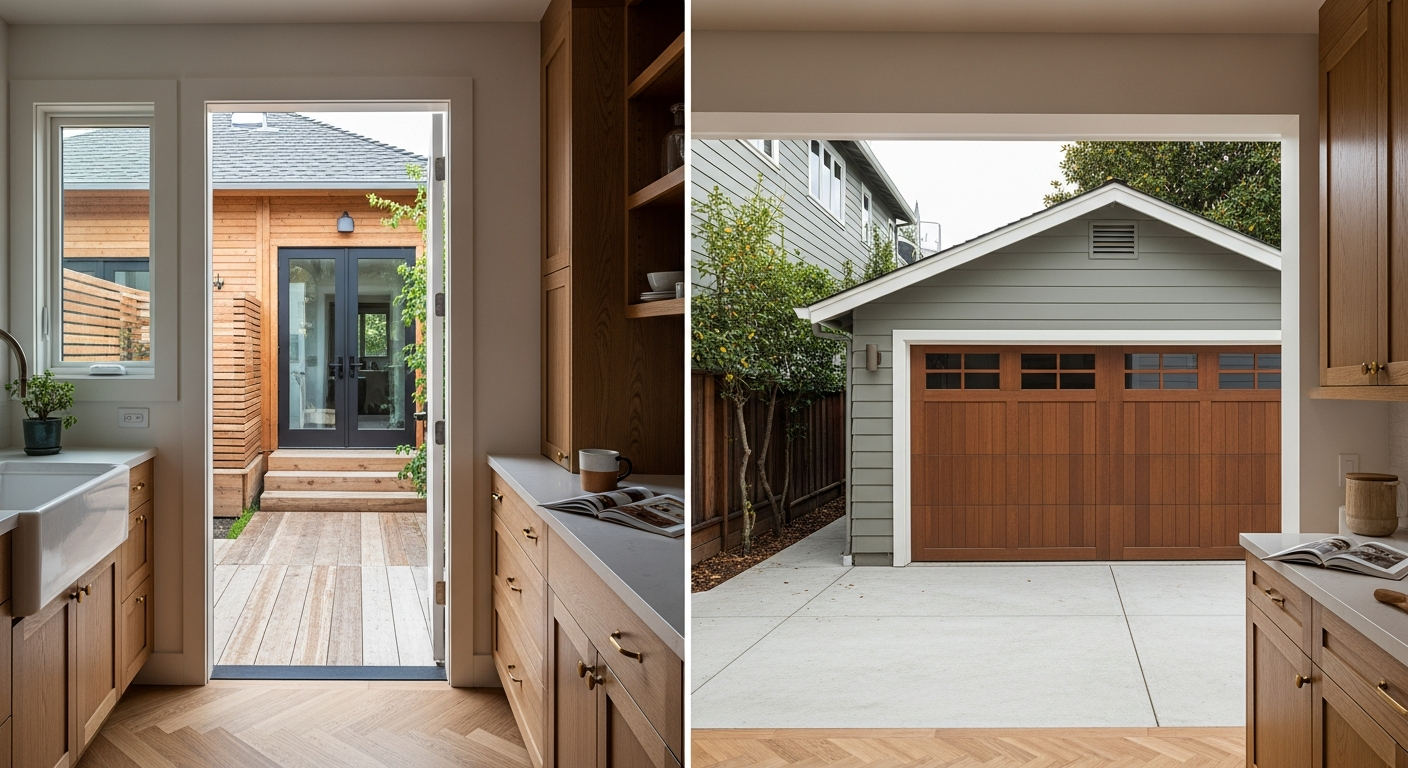
Detached ADU vs Garage Conversion: Which Should Bay Area Homeowners Choose in 2026?
If you're deciding between a detached ADU vs a garage conversion in the Bay Area, here's the short answer: a garage conversion costs $150,000–$250,000 and takes 4–6 months, while a detached ADU costs $280,000–$450,000+ and takes 7–12 months — but a detached unit delivers significantly higher rental income and property value. The right choice depends on your lot size, budget, whether you actually use your garage, and what you want the space to do for you long-term.
I'm Bar Benbenisty, founder of Barcci Builders (CA Contractor License #1086047), and our team has completed over 116 projects across the Bay Area, including dozens of ADUs in Los Gatos, Saratoga, Cupertino, and Palo Alto. I've watched homeowners agonize over this exact decision — and I've seen what happens when they get it right versus when they rush into the wrong option.
This guide breaks down everything you need to know about the detached ADU vs garage conversion debate in 2026: real costs, actual timelines from our project data, permit requirements in Santa Clara County and San Mateo County, design trends, ROI comparisons, and the scenarios where each option clearly wins. Let's get into it.
How Much Does a Garage Conversion ADU Cost in the Bay Area in 2026?
A garage conversion ADU in the Bay Area costs between $150,000 and $250,000 in 2026, based on our project data from completed builds across Silicon Valley. That price range covers converting a standard two-car garage (approximately 400–500 square feet) into a fully permitted, habitable dwelling unit with a kitchen, bathroom, sleeping area, and separate entrance.
Here's why the range is so wide: a basic conversion of a structurally sound garage with an existing concrete slab in good condition sits at the lower end. Once you start addressing foundation issues, raising the roof to meet ceiling height requirements, upgrading the electrical panel to 200 amps, running a new sewer lateral, or choosing premium finishes, costs climb quickly.
Garage Conversion Cost Breakdown (Bay Area 2026)
| Cost Category | Typical Range | Notes |
|---|---|---|
| Design & Permits | $12,000–$25,000 | Architectural plans, Title 24 energy compliance, Santa Clara or San Mateo County permit fees |
| Foundation & Structural | $15,000–$40,000 | Slab reinforcement, new footings if raising roof, seismic upgrades |
| Plumbing (new kitchen & bath) | $18,000–$35,000 | Running new supply/drain lines, water heater, sewer connection |
| Electrical & Panel Upgrade | $10,000–$22,000 | 200-amp panel, dedicated circuits, EV-ready outlet often required |
| HVAC (mini-split system) | $6,000–$12,000 | Mitsubishi or Daikin ductless mini-split is standard |
| Insulation & Drywall | $12,000–$20,000 | R-21 walls, R-38 ceiling per Title 24; spray foam increasingly common |
| Interior Finishes | $35,000–$65,000 | Flooring, cabinetry, countertops, fixtures, appliances, paint |
| Exterior & Windows | $15,000–$30,000 | Replacing garage door with framed wall, adding egress windows, siding to match home |
| Total | $150,000–$250,000 | Based on 2026 Barcci Builders project data |
One thing I tell every homeowner in Campbell and Sunnyvale who asks about garage conversions: don't underestimate the cost of bringing a garage up to habitable standards. Garages were never designed for people to live in. The slab isn't insulated, the walls are often unfinished, there's no plumbing, and the ceiling height may not meet the 7-foot-6-inch minimum. These upgrades add up fast. Based on our experience with 116+ completed projects, I'd say roughly 60% of homeowners who get their first garage conversion quote are surprised by how close the price is to building something new.
How Much Does a Detached ADU Cost in the Bay Area in 2026?
A detached ADU in the Bay Area costs between $280,000 and $450,000+ in 2026 for a typical 600–1,200 square foot unit, according to our project data at Barcci Builders. The per-square-foot cost for a ground-up detached ADU in Silicon Valley ranges from $350 to $500+ depending on size, site conditions, and finish level.
The price difference between a detached ADU and a garage conversion comes down to one fundamental thing: you're building an entirely new structure from the ground up. That means a new foundation, new framing, new roof, new utility connections — everything. But it also means you get exactly the layout, size, and quality you want, without the compromises inherent in working inside an existing garage shell.
Detached ADU Cost Breakdown (Bay Area 2026)
| Cost Category | Typical Range | Notes |
|---|---|---|
| Design, Engineering & Permits | $20,000–$40,000 | Architectural plans, structural engineering, soils report, Title 24, permit fees |
| Site Prep & Foundation | $30,000–$60,000 | Grading, concrete slab or raised foundation, drainage systems |
| Framing & Roofing | $40,000–$75,000 | Wood or steel framing, standing seam metal or composite roof |
| Plumbing | $22,000–$40,000 | Full kitchen and bath, tankless water heater, sewer lateral |
| Electrical | $15,000–$28,000 | Sub-panel, recessed lighting, smart home wiring, EV outlet |
| HVAC | $8,000–$16,000 | Mini-split system or small ducted system |
| Exterior Finishes | $25,000–$50,000 | Cedar cladding, natural stone veneer, stucco, fiber cement siding, windows, doors |
| Interior Finishes | $50,000–$100,000+ | Herringbone wood floors, quartz or Dekton countertops, zellige tile backsplash, custom cabinetry |
| Landscaping & Hardscape | $15,000–$35,000 | Pathway, privacy plantings, patio area, outdoor lighting |
| Total | $280,000–$450,000+ | Based on 2026 Barcci Builders project data, 600–1,200 sq ft |
As someone who's completed over 116 remodels and new builds across the Bay Area, I'll say this: a detached ADU is not just a bigger investment — it's a fundamentally different investment. You're adding a real, standalone structure to your property that functions like a small home. In neighborhoods like Los Altos, Downtown Los Gatos, or Professorville in Palo Alto, where lot values are exceptionally high, that additional dwelling unit can add $200,000–$400,000 in appraised property value.
Our team designs detached ADUs using our 3D design rendering service, which allows homeowners to visualize their ADU on their actual property before we break ground. This step alone saves thousands in change orders and helps homeowners make confident finish selections — whether that's rift-cut white oak cabinetry, Calacatta Viola marble countertops, or Dekton Kreta surfaces for indoor-outdoor continuity.
Detached ADU vs Garage Conversion: Side-by-Side Comparison for 2026
The best way to decide between a detached ADU and a garage conversion is to see them compared across every factor that matters: cost, timeline, rental income, property value, design flexibility, and permit complexity. Here's the comprehensive comparison based on our Bay Area project data.
| Factor | Garage Conversion ADU | Detached ADU |
|---|---|---|
| Typical Cost (2026) | $150,000–$250,000 | $280,000–$450,000+ |
| Cost Per Square Foot | $300–$500 | $350–$500+ |
| Typical Size | 400–500 sq ft | 600–1,200 sq ft |
| Construction Timeline | 4–6 months | 7–12 months |
| Permit Timeline (Santa Clara County) | 4–8 weeks | 6–12 weeks |
| Design Flexibility | Limited by existing garage footprint and structure | Full control over layout, size, orientation, and style |
| Ceiling Height | Often constrained (may need roof raise) | Designed to spec (vaulted ceilings, 9–10 ft standard) |
| Rental Income Potential (monthly) | $2,000–$3,200 | $2,800–$5,500+ |
| Property Value Increase | $100,000–$200,000 | $200,000–$400,000+ |
| Garage Parking Lost | Yes — entire garage becomes living space | No — garage remains intact |
| Privacy (for main home) | Attached or adjacent to home | Separate structure with its own entrance and yard |
| Best For | Tight budgets, small lots, quick timelines | Maximum ROI, multigenerational living, long-term rental income |
One pattern I've noticed across our projects: homeowners who plan to rent out their ADU almost always wish they'd gone bigger. A 450 square foot converted garage in Mountain View rents for around $2,800/month in 2026, while a well-designed 800 square foot detached ADU in the same neighborhood commands $4,200–$4,800/month. The $100,000–$200,000 difference in construction cost pays for itself within 3–5 years through the rental income differential.
On the flip side, homeowners who need a home office, guest suite, or caregiver unit — and who don't plan to rent the space — often find that a garage conversion gives them exactly what they need at a significantly lower cost. Context matters enormously.
What Are the ADU Permit Requirements in Santa Clara County and San Mateo County in 2026?
Both garage conversions and detached ADUs require building permits in Santa Clara County and San Mateo County, but California's ADU-friendly legislation (AB 2221, SB 897, AB 976, and the 2024 updates) has dramatically streamlined the process. Most jurisdictions must approve ADU permits ministerially — meaning no discretionary review, no public hearings, and no neighbor approval required.
Here's what you need to know about ADU permits in the Bay Area for 2026:
Santa Clara County ADU Permit Requirements
- Maximum detached ADU size: Up to 1,200 square feet for properties with an existing single-family home
- Setbacks for detached ADU: 4-foot rear and side setbacks (state minimum); some cities like Los Gatos and Saratoga have adopted these minimums
- Garage conversions: No setback requirements when converting within the existing garage footprint — even if the garage is on the property line
- Height limit: Up to 16 feet for detached ADUs (18 feet within 0.5 miles of transit in some jurisdictions)
- Parking: No replacement parking required when converting a garage to an ADU (per state law)
- Permit timeline: Jurisdictions must act on ADU applications within 60 days of a complete submittal
- Impact fees: Waived for ADUs under 750 square feet; reduced fees for larger units
San Mateo County ADU Permit Requirements
- Same state-mandated rules apply — cities like Menlo Park, Redwood City, and Burlingame follow similar streamlined processing
- Owner-occupancy requirement: Eliminated for most ADUs through 2030 under AB 976
- Utility connections: Separate utility meters may be required for detached ADUs; garage conversions often share the main home's utilities
- Design review: Cannot be applied to ADUs in most cases — your ADU doesn't need to match your main home's architectural style (though we always recommend design cohesion)
The single biggest advantage garage conversions have in the permitting process is simplicity. Because you're working within an existing footprint, there's no site plan review for setbacks, no new foundation inspection sequence, and fewer structural engineering requirements. Our 2026 project data shows that garage conversion permits in Santa Clara County are approved in 4–8 weeks on average, while detached ADU permits take 6–12 weeks due to additional plan check requirements for new construction.
Regardless of which route you choose, I strongly recommend working with a design-build contractor experienced in Bay Area ADUs who handles both the design and construction. This eliminates the coordination headaches between architect and builder and dramatically reduces permit rejection and revision cycles.
When Does a Garage Conversion Make More Sense Than a Detached ADU?
A garage conversion makes more sense than a detached ADU when your budget is under $250,000, your timeline is tight, your lot doesn't have room for a new structure, or you need a functional space quickly without maximizing rental income. It's the practical choice in specific, well-defined scenarios.
After building ADUs across the Bay Area for years, here are the situations where I steer clients toward a garage conversion:
- Budget constraints: If your total budget is $150,000–$250,000, a garage conversion gives you a fully finished, permitted living space. A detached ADU at that budget would need to be extremely small (under 500 sq ft) with builder-grade finishes.
- Small or narrow lots: Many older homes in San Jose, Campbell, and Sunnyvale sit on 5,000–6,000 square foot lots. After accounting for the main home's footprint, required setbacks, and usable yard space, there's often not enough room for a detached structure. Converting the existing garage solves the space equation.
- Speed: Garage conversions take 4–6 months from permit to move-in. Detached ADUs take 7–12 months. If you have an aging parent who needs housing in the next 6 months, the garage conversion timeline is far more realistic.
- You don't use your garage for cars: Let's be honest — 78% of our Bay Area clients with two-car garages use them primarily for storage. If your cars are already in the driveway, converting that 450 square feet of glorified storage into a $2,500/month rental unit is one of the highest-ROI moves you can make.
- Home office or studio use: If you work from home and need a quiet, separate workspace — not a full dwelling unit — a garage conversion can be designed as a non-ADU accessory structure at even lower cost.
The key compromise with a garage conversion is this: you're limited by the existing structure. Most two-car garages in Bay Area homes built between 1950–1990 are 400–500 square feet with 8-foot ceilings. That's enough for a comfortable studio or one-bedroom unit, but it won't accommodate a full two-bedroom layout that commands the highest rents.
When Should You Build a Detached ADU Instead of Converting Your Garage?
Build a detached ADU instead of converting your garage when you want maximum rental income, need a larger living space (800+ square feet), plan for multigenerational living with full privacy, or want to preserve your garage for parking and storage. A detached ADU is the premium choice that delivers premium returns.
Here are the scenarios where a detached ADU is clearly the better investment:
- Long-term rental income: In Silicon Valley's 2026 rental market, the difference between a 450 sq ft converted garage and an 800 sq ft detached ADU is $1,500–$2,000/month in rental income. Over 10 years, that's $180,000–$240,000 in additional revenue — far more than the construction cost differential.
- Multigenerational living: If aging parents or adult children will live in the ADU, a detached unit provides real privacy and independence for both households. Separate entrance, separate yard space, no shared walls. This matters enormously for family harmony.
- You need your garage: Homes in hillside communities like Los Gatos, Saratoga, and Woodside often have limited street parking. Losing your garage means your cars are exposed to weather and your belongings need alternative storage. A detached ADU keeps your garage intact.
- Lot size allows it: If your lot is 7,000+ square feet, you likely have room for a well-placed detached ADU that doesn't sacrifice your outdoor living space. Our team uses 3D renderings to show exactly how a detached ADU fits on your specific property before you commit.
- Design flexibility: With a detached ADU, you choose the layout from scratch. Vaulted ceilings with exposed beams, a full-size kitchen with Thermador or Bosch appliances, a walk-in shower with zellige tile, herringbone white oak floors, hand-applied plaster walls — none of these are constrained by an existing structure.
- Property value: According to Bay Area appraisal data, a well-built detached ADU adds approximately 20–35% of its construction cost to the home's appraised value. For a $400,000 detached ADU in Los Gatos or Palo Alto, that's $80,000–$140,000 in immediate equity — on top of the rental income stream.
The 2026 design trends we're seeing in detached ADUs across the Bay Area reflect what buyers and renters want: warm, organic, and thoughtful spaces. Think rift-cut white oak cabinetry with integrated finger pulls, Dekton or quartzite countertops, warm earthy tones (Sherwin-Williams Urbane Bronze, Benjamin Moore White Heron), fluted detail panels, microcement bathroom walls, plaster range hoods, unlacquered brass fixtures by brands like Waterworks or California Faucets, and induction cooktops by Miele or Bosch. These aren't luxury-only finishes anymore — they're what distinguishes an ADU that rents for $3,000/month from one that rents for $5,000/month.
How to Decide: A Step-by-Step Framework for Bay Area Homeowners
The best way to decide between a detached ADU and a garage conversion is to answer five questions about your property, budget, goals, timeline, and lifestyle. I walk every prospective client through this exact framework during our initial consultation.
Step 1: Assess Your Lot
Walk your backyard. Is there a 20x30-foot area (600 sq ft) or larger that isn't occupied by the main home, pool, mature trees you want to keep, or septic system (in unincorporated areas)? If yes, a detached ADU is physically feasible. If not, a garage conversion may be your only practical option.
Step 2: Define Your Budget
Be honest about what you can spend. If your budget is under $250,000, a garage conversion is the right path. If you have $300,000–$450,000+ available — through savings, a home equity line of credit (HELOC), or a construction loan — a detached ADU opens up significantly more possibilities.
Step 3: Clarify Your Goals
- Rental income: Detached ADU wins (higher rent, broader tenant appeal)
- Family housing: Detached ADU wins (privacy, independence, larger size)
- Home office: Garage conversion wins (lower cost, faster build, simpler permits)
- Guest suite: Either works — choose based on budget and lot
- Maximum property value: Detached ADU wins
Step 4: Check Your Timeline
Based on our 2026 project data, the average garage conversion in the Bay Area takes 4–6 months from permit to completion. A detached ADU takes 7–12 months. If you need the space within 6 months, a garage conversion is the realistic choice.
Step 5: Evaluate What You're Giving Up
With a garage conversion, you lose your garage permanently. That means no covered parking, no workshop space, and you'll need to find other storage solutions. With a detached ADU, you lose yard space — but your garage stays intact. For many homeowners in dense neighborhoods of Santa Clara and Milpitas, losing the garage is a non-issue because they never park inside it anyway.
If you'd like our team to walk through this framework with you using your specific property dimensions and goals, we offer free ADU consultations across the Bay Area. We'll review your lot, discuss both options honestly, and give you preliminary pricing before you commit to anything.
Frequently Asked Questions
How much does a detached ADU cost in the Bay Area in 2026?
A detached ADU in the Bay Area costs between $280,000 and $450,000+ in 2026 for a unit between 600 and 1,200 square feet, according to our data from 116+ completed Barcci Builders projects. The per-square-foot cost ranges from $350 to $500+ depending on size, site conditions (slope, access, soil quality), and finish level. Premium finishes like Dekton countertops, rift-cut white oak cabinetry, and zellige tile push costs toward the higher end. A basic but well-built detached ADU on a flat, accessible lot with mid-range finishes typically lands around $320,000–$380,000.
Is it cheaper to convert a garage to an ADU or build a detached ADU?
Converting a garage to an ADU is cheaper — typically $150,000–$250,000 compared to $280,000–$450,000+ for a detached ADU in the Bay Area in 2026. However, the per-square-foot cost is often surprisingly close ($300–$500 for garage conversions vs. $350–$500+ for detached). The major cost difference comes from not needing a new foundation, new framing, or a new roof in a garage conversion. That said, many homeowners are surprised to learn that garage conversions still require significant investment to bring the structure up to habitable standards — including insulation, plumbing, electrical upgrades, HVAC, and replacing the garage door with a properly framed wall.
Do I need a permit to convert my garage to an ADU in California?
Yes, you need a building permit to convert a garage to an ADU in California. However, California's ADU laws (including AB 2221, SB 897, and AB 976) require cities and counties to process ADU permits ministerially, meaning no discretionary review or public hearings. In Santa Clara County, garage conversion ADU permits are typically approved within 4–8 weeks of a complete application submittal. You do not need to provide replacement parking when converting a garage to an ADU — this is protected by state law. You also don't need neighbor approval. A licensed contractor familiar with your local jurisdiction's requirements can handle the entire permitting process.
How long does it take to build a detached ADU in Silicon Valley?
Based on our 2026 project data at Barcci Builders, a detached ADU in Silicon Valley takes 7–12 months from permit submittal to move-in ready completion. That breaks down as follows: 6–12 weeks for permit approval, 1–2 weeks for site preparation and foundation work, 12–20 weeks for framing, rough mechanical, and exterior envelope, and 8–12 weeks for interior finishes and final inspections. The biggest variables are permit processing times (which vary by city), weather delays during foundation and framing, and the availability of specialty materials and subcontractors. Garage conversions are faster, averaging 4–6 months total.
Does a garage conversion or detached ADU add more property value?
A detached ADU adds more property value than a garage conversion in virtually every scenario. Based on Bay Area appraisal data and our project experience, a well-built detached ADU adds approximately 20–35% of its construction cost in immediate property value, plus the capitalized value of its rental income stream. In high-value markets like Los Gatos, Palo Alto, Los Altos, and Menlo Park, a detached ADU can add $200,000–$400,000+ to a home's appraised value. A garage conversion adds less — typically $100,000–$200,000 — partly because it's smaller and partly because you've eliminated the garage, which some appraisers and buyers view as a negative.
What is the maximum size ADU I can build in Santa Clara County?
In Santa Clara County, the maximum size for a detached ADU is 1,200 square feet on a property with an existing single-family home, per California state law. For a garage conversion, the ADU can be as large as the existing garage footprint — even if that exceeds 1,200 square feet (though most Bay Area garages are 400–500 square feet). Additionally, you can build both a detached ADU and a Junior ADU (JADU) of up to 500 square feet within the main home, giving you up to 1,700 square feet of additional living space on a single-family lot.
Can I rent out a garage conversion ADU in the Bay Area?
Yes, you can rent out a garage conversion ADU in the Bay Area. California law (AB 976, effective 2024) eliminated the owner-occupancy requirement for most ADUs through at least 2030, meaning you do not need to live on the property to rent out the ADU. In 2026, a garage conversion ADU (typically 400–500 square feet) in the Bay Area rents for approximately $2,000–$3,200 per month depending on location, finishes, and proximity to transit and employment centers. A comparable garage conversion in Mountain View or Sunnyvale commands higher rents than one in outer San Jose or Milpitas due to proximity to major tech employers.
What design trends are popular for Bay Area ADUs in 2026?
The most popular ADU design trends in the Bay Area in 2026 focus on warm, organic, and high-end residential aesthetics rather than the sterile white box look. Based on our project data at Barcci Builders, the top trends include: rift-cut white oak cabinetry and flooring (including herringbone patterns), Dekton or quartzite countertops (Dekton Kreta and Caesarstone Empira White are popular), zellige tile backsplashes and shower walls, plaster range hoods and hand-applied plaster accent walls, microcement bathroom surfaces, fluted detail panels, unlacquered brass fixtures and hardware, integrated finger pulls (no visible handles), induction cooktops by Miele or Bosch, cedar cladding or natural stone veneer on exteriors, warm earthy color palettes, and large-format sliding glass doors for indoor-outdoor flow.