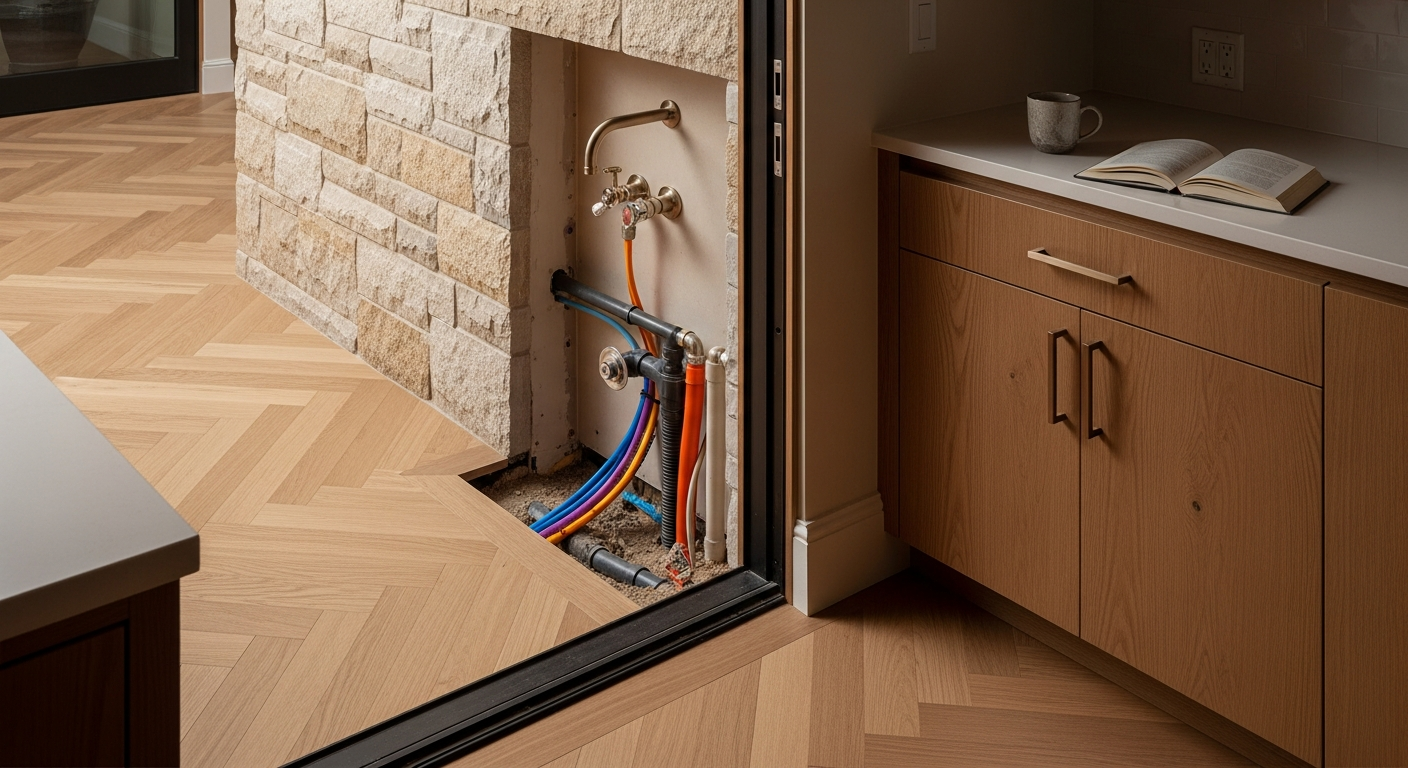
How Much Do ADU Utility Connections Cost in California in 2026?
ADU utility connections in California cost between $15,000 and $65,000 in 2026, depending on the distance from existing utility mains, soil conditions, permit requirements, and whether your local municipality charges impact or capacity fees. Based on our 116+ completed Bay Area projects at Barcci Builders, the average homeowner in Santa Clara County spends approximately $28,000–$45,000 on combined water, sewer, gas, and electric connections for a detached ADU.
I'm Bar Benbenisty, founder of Barcci Builders (CA License #1086047), and utility connections are consistently the most underestimated cost in ADU construction. Homeowners budget meticulously for finishes — the rift-cut white oak cabinetry, the Dekton countertops, the zellige backsplash tile — but then get blindsided by a $12,000 sewer lateral or a $9,500 electrical panel upgrade they didn't see coming.
The reality is that utility hookups typically account for 10%–20% of total ADU construction costs in the Bay Area. In cities like Los Gatos, Saratoga, and Palo Alto, where older infrastructure and hillside lots are common, these costs can climb even higher. Let me walk you through exactly what to expect for each utility so you can budget accurately before breaking ground.
What Are the Four Main ADU Utility Hookups and What Does Each Cost?
Every ADU in California requires four primary utility connections: water supply, sanitary sewer (or septic), natural gas, and electrical service. Each has its own permitting process, contractor specialty, inspection requirements, and fee structure. Here's a detailed breakdown based on our 2026 Bay Area project data.
| Utility Connection | Bay Area Cost Range (2026) | Average Cost | Typical Timeline | Key Cost Driver |
|---|---|---|---|---|
| Water Supply Line | $3,000–$15,000 | $6,500 | 1–3 weeks | Distance to water main; meter fees |
| Sewer Lateral | $4,000–$20,000 | $9,800 | 1–4 weeks | Depth of existing sewer; soil conditions |
| Natural Gas Line | $2,500–$8,000 | $4,200 | 1–2 weeks | Distance from gas meter; PG&E scheduling |
| Electrical Service | $4,000–$22,000 | $8,500 | 2–6 weeks | Panel upgrade requirements; underground vs overhead |
| Combined Total | $13,500–$65,000 | $29,000 | 4–10 weeks | Site-specific conditions |
As someone who's completed over 116 remodels and ADU builds across the Bay Area, the single biggest mistake I see homeowners make is assuming they can share all utilities with the main house without any upgrades. California building code — specifically the 2022 California Residential Code as adopted for 2026 — requires that ADU utility capacity be verified and, in most cases, independently metered or sub-metered.
Water Supply Connection Details
Your ADU water supply line connects from either your existing water meter or a new dedicated meter to the ADU structure. In Santa Clara County, San Jose Water Company charges $5,800–$8,200 for a new ¾-inch water meter installation in 2026, while cities served by Cal Water (including parts of Los Gatos) charge approximately $6,500–$9,000. If your ADU shares the existing meter — which California law (AB 68 and SB 13 updates) generally allows for ADUs under 750 square feet — you'll save significantly, typically paying only $3,000–$5,000 for the physical pipe run and connection.
Sewer Lateral Connection Details
The sewer connection is frequently the most expensive and unpredictable utility hookup. A new sewer lateral involves trenching from your ADU to either the existing house sewer line or directly to the city main in the street. In our experience across Cupertino, Mountain View, and Campbell, sewer laterals run $4,000–$12,000 when tying into the existing house lateral and $8,000–$20,000 when a new independent connection to the street main is required. West Valley Sanitation District, which serves much of the South Bay, charges a capacity fee of approximately $4,800–$6,200 for a new ADU sewer connection in 2026.
Natural Gas Line Details
Gas line installation for ADUs is relatively straightforward. A licensed plumber or gas fitter runs a new gas line — typically ¾-inch or 1-inch black iron or CSST (corrugated stainless steel tubing) — from your existing gas meter to the ADU. PG&E does not typically require a separate gas meter for ADUs, which saves $3,000–$5,000 in meter fees. The main cost variable is distance: our 2026 project data shows gas line installation averaging $35–$55 per linear foot in the Bay Area, including trenching and backfill. A typical 40-foot run costs $2,500–$4,500.
One important 2026 trend: many of our clients in Palo Alto and Menlo Park are building all-electric ADUs with induction cooktops and heat pump HVAC, eliminating the gas connection entirely and saving $2,500–$8,000. Cities with natural gas bans on new construction (such as San Jose's reach code) may require this approach.
Electrical Service Details
Electrical is often the second-most expensive utility connection, largely because many Bay Area homes built before 1990 have 100-amp or 125-amp main panels that cannot support an ADU's additional load. Upgrading to a 200-amp panel costs $3,500–$6,500 for the panel alone, plus $1,500–$4,000 for PG&E to upgrade the service drop. From there, running a sub-panel to the ADU — typically a 60-amp or 100-amp sub-panel — costs $2,500–$8,000 depending on distance and whether the run is underground (required in most Bay Area jurisdictions) or overhead.
Do You Need a Separate Utility Meter for an ADU in California?
California law does not require separate utility meters for most ADUs, and in fact, AB 68 and SB 13 explicitly prohibit local agencies from requiring new utility connections or separate meters for ADUs built within an existing structure or on a single-family lot — provided the existing infrastructure has adequate capacity. However, there are important nuances that affect your costs.
Here's when separate metering is required, optional, or prohibited in 2026:
| Scenario | Separate Water Meter | Separate Electric Meter | Separate Gas Meter | Separate Sewer |
|---|---|---|---|---|
| Attached ADU under 750 sq ft | Not required | Not required | Not required | Not required (tie into existing lateral) |
| Detached ADU under 750 sq ft | Not required (but recommended for rentals) | Not required (sub-panel OK) | Not required | Tie into existing or new lateral depending on jurisdiction |
| Detached ADU 750–1,200 sq ft | May be required by water district | Sub-panel OK; separate meter optional | Not required | Often requires new or upgraded lateral |
| ADU intended for sale (SB 9 lot split) | Required (separate parcel) | Required | Required if gas service is provided | Required (independent lateral) |
For rental ADUs — which make up about 70% of the ADU projects we build — I generally recommend installing a sub-meter for electricity even when not required. A sub-meter costs $300–$800 to install and allows you to fairly bill tenants for usage, which simplifies landlord-tenant relationships. We install Emporia Vue or Sense energy monitors on many of our ADU builds for this purpose.
The important thing to know is that utility districts and cities operate independently on fee structures. San Jose Water Company, Cal Water, Great Oaks Water Company, and Purissima Hills Water District each have different capacity fees and connection requirements. Always confirm with your specific utility provider before finalizing your budget.
How Long Does It Take to Connect Utilities to an ADU in the Bay Area?
Utility connections for a Bay Area ADU typically take 4–10 weeks from permit approval to final inspection, but the total timeline including permit processing and utility company scheduling can stretch to 12–20 weeks. Based on our 2026 project data, here's a realistic timeline breakdown.
The physical installation of utility connections — the actual trenching, pipe laying, wire pulling, and connection work — typically takes 2–4 weeks when properly scheduled. The real delays come from three sources:
- Permit processing: Santa Clara County Building Department currently processes ADU utility permits in 4–8 weeks. San Mateo County Building Department averages 3–6 weeks. Cities with over-the-counter ADU permit processing (like San Jose for qualifying projects) can approve in 1–2 weeks.
- PG&E scheduling: If you need a panel upgrade, service drop modification, or new gas service, PG&E scheduling is the single biggest bottleneck. In 2026, PG&E service appointments in the South Bay are running 6–12 weeks out from the date of request. I cannot stress this enough — submit your PG&E service request the moment your plans are in review, not after permit approval.
- Utility district inspections: Water and sewer districts require inspections at multiple stages (trench open, pressure test, backfill, and final). Each inspection can add 3–7 business days of waiting.
Here's my #1 timeline tip for Bay Area ADU builders: coordinate your utility work during the foundation and framing phases, not after. Our team at Barcci Builders runs utility trenching concurrently with foundation work, which saves 3–5 weeks on the overall project schedule. Water, sewer, and gas rough-ins should be complete before the slab is poured or the crawlspace is enclosed. Electrical rough-in happens during framing. If you sequence these correctly, utility connections add zero extra weeks to your overall ADU construction timeline of 5–8 months.
What Permits and Fees Do California Cities Charge for ADU Utility Connections?
California cities charge between $2,000 and $18,000 in utility-related permit fees and impact fees for ADU connections in 2026, though state law has significantly reduced these fees compared to standard new construction. AB 2221 and subsequent legislation prohibit cities from charging utility connection fees for ADUs under 750 square feet, and fees for larger ADUs must be proportional to their size relative to the primary dwelling.
Here's what you'll actually pay in specific Bay Area cities based on our recent project experience:
- Los Gatos: No sewer or water capacity fees for ADUs under 750 sq ft. ADUs 750–1,200 sq ft pay approximately $4,200–$6,800 in combined utility fees. Town of Los Gatos Planning Department processes ADU permits relatively efficiently at 4–6 weeks.
- Saratoga: West Valley Sanitation District capacity fee of approximately $4,800 for new sewer connections. Saratoga limits ADU utility impact fees per state law. Expect $3,500–$7,500 in total utility-related fees.
- Cupertino: Cupertino Sanitary District charges $3,200–$5,400 for sewer capacity. Cal Water connection fees add $1,800–$3,500. Total utility fees: $5,000–$9,000 for ADUs over 750 sq ft.
- Palo Alto: City of Palo Alto Utilities (CPAU) — the only municipal electric utility in the South Bay — charges $2,500–$4,800 for new electric service connections. Palo Alto also provides municipal water and gas, simplifying the process. Total utility fees: $4,000–$8,500.
- San Jose: San Jose has streamlined ADU utility fees significantly. San Jose Water Company charges $5,800–$8,200 for new meters. The city's sewer capacity fee for ADUs is approximately $2,800–$4,600. San Jose Environmental Services Department manages sewer connections.
- Mountain View: The city waives utility connection fees for ADUs under 750 sq ft. For larger units, expect $3,800–$7,200 in combined fees.
One critical note: utility impact fees and connection fees are separate from your construction costs. The $15,000–$65,000 range I quoted earlier for physical utility connections is your contractor's cost for labor, materials, and equipment. The $2,000–$18,000 in permit and capacity fees are paid directly to the city and utility districts on top of that. Our 2026 project data shows the average total cost (construction + fees) for Bay Area ADU utility connections is $32,000–$52,000.
Can You Build an All-Electric ADU in California to Avoid Gas Connection Costs?
Yes — and in 2026, approximately 45% of our Bay Area ADU clients are choosing all-electric construction, which eliminates the $2,500–$8,000 gas line connection entirely. All-electric ADUs use induction cooktops, heat pump water heaters, and heat pump HVAC systems instead of gas-powered appliances. This approach aligns with California's 2022 Energy Code (Title 24 Part 6), which strongly incentivizes electrification through favorable compliance pathways.
The economics of all-electric ADUs have shifted dramatically. Here's a realistic comparison:
| Category | Gas + Electric ADU | All-Electric ADU | Savings / (Extra Cost) |
|---|---|---|---|
| Gas line connection | $2,500–$8,000 | $0 | $2,500–$8,000 saved |
| Gas appliances (range, furnace, water heater) | $4,500–$9,000 | $0 | Replaced by electric equivalents |
| Induction cooktop (e.g., Bosch or Fisher & Paykel) | N/A | $1,200–$3,500 | ($1,200–$3,500) extra |
| Heat pump water heater (e.g., Rheem ProTerra) | N/A | $2,000–$3,800 | ($500–$1,500) extra vs gas |
| Heat pump HVAC (e.g., Mitsubishi mini-split) | Furnace: $3,000–$5,000 | $3,500–$6,000 | ($500–$1,000) extra |
| Electrical panel capacity needed | 60-amp sub-panel | 100-amp sub-panel | ($800–$2,000) extra |
| Net Savings (Typical) | — | — | $1,500–$4,500 net saved |
Beyond the upfront savings, all-electric ADUs qualify for significant incentives in 2026. The federal Inflation Reduction Act provides up to $2,000 in tax credits for qualifying heat pump installations and up to $840 in point-of-sale rebates through the Home Electrification and Appliance Rebates (HEAR) program. BayREN (Bay Area Regional Energy Network) offers additional rebates of $1,000–$3,500 for all-electric new construction in participating jurisdictions.
Several Bay Area cities now require or strongly incentivize all-electric new construction for ADUs. San Jose's reach code, effective since 2023, requires all-electric construction for new buildings. Berkeley, Mountain View, and portions of unincorporated San Mateo County have similar provisions. If you're building in these jurisdictions, you don't have a choice — but the financial math works in your favor anyway.
For our ADU projects in Los Gatos and Saratoga, where gas service is still permitted, I still recommend all-electric for most clients. The combination of lower upfront utility connection costs, ongoing energy savings, and future-proofing against California's planned gas phase-out makes it the smarter investment in 2026.
How to Reduce ADU Utility Connection Costs in the Bay Area
The most effective way to reduce ADU utility connection costs is strategic site planning that minimizes the distance between your ADU and existing utility infrastructure. Every additional foot of trenching adds $35–$85 to your project depending on soil conditions and utility type. Based on our experience building ADUs across Los Altos, San Jose, and surrounding cities, here are the most impactful cost-saving strategies.
1. Position Your ADU Close to Existing Utilities
This sounds obvious, but it's the single most impactful design decision. An ADU placed 20 feet from your existing sewer cleanout costs $4,000–$6,000 for the sewer connection. The same ADU placed 60 feet away costs $8,000–$14,000. During our 3D design and rendering phase, we map all existing utility locations and optimize ADU placement to minimize run distances while maintaining setback compliance.
2. Share the Existing Water Meter
California law allows ADUs to share the existing water meter. Avoiding a new water meter saves $5,800–$9,000 in meter fees alone. The tradeoff is that you'll pay a single water bill covering both the main house and ADU, but for most rental situations, you can include water in the rent and adjust accordingly.
3. Go All-Electric
As detailed above, eliminating the gas connection saves $2,500–$8,000. This is the easiest utility cost reduction available in 2026.
4. Trench Smart — Combine Utility Runs
Water, sewer, gas (if applicable), and electric lines can share a single trench with proper separation distances (typically 12–24 inches between different utilities per California Plumbing Code). A single combined trench costs 40%–60% less than four separate trenches. Our team always runs combined utility trenches when code allows.
5. Upgrade Your Main Panel Proactively
If your home's main panel is already due for an upgrade — which is common in homes built before 1985 in neighborhoods like Willow Glen in San Jose or Old Mountain View — rolling the panel upgrade into your ADU project is significantly cheaper than doing it as a standalone project later. The marginal cost of upgrading from 100-amp to 200-amp during ADU construction is $2,500–$4,500, versus $5,000–$8,000 as a standalone project.
6. Apply for Available Rebates and Incentives
In 2026, Bay Area homeowners can access: CalHFA ADU Grant Program (up to $40,000 for qualifying ADUs, which can cover utility connections), TECH Clean California incentives for heat pump installations ($1,000–$3,000), and local utility rebates from PG&E or municipal utilities. Santa Clara County also offers an ADU forgivable loan program that can offset permitting and utility costs.
Frequently Asked Questions
How much does it cost to connect water to an ADU in California?
Connecting water to an ADU in California costs between $3,000 and $15,000 in 2026, depending on whether you share the existing water meter or install a new one. Sharing the existing meter (allowed by California law for most ADUs) costs $3,000–$5,000 for the physical pipe run. A new dedicated water meter adds $5,800–$9,000 in meter fees from companies like San Jose Water Company or Cal Water. Based on our 116+ completed Bay Area projects, the average water connection for a detached ADU in Santa Clara County is approximately $6,500.
Does PG&E charge for ADU electrical connections in the Bay Area?
PG&E does not charge a standard connection fee for ADU electrical service if the existing service has adequate capacity. However, if your home requires a panel upgrade or service drop modification, PG&E charges $1,500–$4,000 for the utility-side work (meter base, service drop, transformer). The homeowner-side electrical work — panel upgrade, sub-panel installation, and underground conduit to the ADU — costs an additional $2,500–$18,000 depending on scope. In 2026, PG&E scheduling for service modifications in the South Bay runs 6–12 weeks, so early planning is essential. Cities served by municipal utilities like Palo Alto (CPAU) or Silicon Valley Power (Santa Clara) have different fee structures.
Can I connect my ADU to the existing sewer line in California?
Yes, California law allows ADUs to connect to the existing house sewer lateral in most cases. This is the most cost-effective approach, typically costing $4,000–$12,000 depending on distance and soil conditions. However, some jurisdictions and sanitary districts require a video inspection of the existing lateral to verify it's in good condition before allowing a new connection. If the existing lateral is clay pipe or shows signs of damage, you may need to replace it ($8,000–$15,000) or install a new independent lateral to the street main ($12,000–$20,000). West Valley Sanitation District and Cupertino Sanitary District both require lateral inspections before approving ADU connections.
Do I need a separate electrical panel for my ADU in California?
Yes, California building code requires a dedicated sub-panel at the ADU location. A typical ADU sub-panel is 60 amps for small units (under 500 sq ft) or 100 amps for larger units and all-electric ADUs. The sub-panel itself costs $800–$2,000 installed, but the total electrical connection cost — including the feed from the main panel, underground conduit, wire, and potential main panel upgrade — ranges from $4,000 to $22,000 in the Bay Area. Based on our 2026 project data, approximately 60% of Bay Area homes with ADU projects require a main panel upgrade from 100-amp to 200-amp service to support the additional load.
How far can an ADU be from existing utility connections?
There is no maximum distance set by California code for ADU utility connections, but cost increases significantly with distance. Based on our Bay Area projects, utility trenching costs $35–$85 per linear foot depending on the utility type and soil conditions. A detached ADU located 30 feet from existing utilities typically costs $13,500–$30,000 for all connections, while one located 80 feet away can cost $25,000–$55,000+. Rocky soil conditions common in hillside areas of Los Gatos, Saratoga, and Los Altos Hills can increase trenching costs by 40%–100% due to the need for mechanical excavation or rock sawing.
Are ADU utility connection fees waived in California in 2026?
California law waives most impact and connection fees for ADUs under 750 square feet. For ADUs between 750 and 1,200 square feet, cities can charge proportional fees — typically 40%–60% of what a standard new home would pay. However, fees charged directly by utility districts (water companies, sanitary districts) are generally not waived, as these entities operate independently from city planning departments. In practical terms, a qualifying ADU under 750 sq ft in the Bay Area saves $3,000–$12,000 in fees compared to a larger ADU. This is one reason we often recommend designing ADUs at 749 square feet when the homeowner's program allows it.
How long does it take PG&E to connect electricity to a new ADU?
PG&E currently takes 6–12 weeks to schedule and complete electrical service modifications for ADU projects in the South Bay and Peninsula as of 2026. The process involves submitting a service application through PG&E's online portal, receiving an engineering review (2–4 weeks), scheduling a field visit (2–4 weeks), and completing the utility-side work (1–2 days). Our strong recommendation is to submit the PG&E service application the moment your ADU plans enter the permit review process — not after you receive your building permit. This parallel processing can save 6–10 weeks on your overall project timeline.
Is it cheaper to build an all-electric ADU or one with gas connections in the Bay Area?
An all-electric ADU is typically $1,500–$4,500 cheaper to build than a gas-and-electric ADU in the Bay Area in 2026. You save $2,500–$8,000 by eliminating the gas line connection, but spend $2,000–$3,500 more on electric appliances (induction cooktop, heat pump water heater, heat pump HVAC) and a larger electrical sub-panel. After federal and state electrification rebates of $1,000–$5,000, the savings increase further. Additionally, all-electric ADUs have lower operating costs — our clients report 15%–30% lower monthly utility bills compared to gas-equipped units. Based on our 2026 project data, approximately 45% of our Bay Area ADU clients choose all-electric construction.