How Much Does an ADU Cost in Palo Alto in 2026?
A fully permitted ADU in Palo Alto costs between $285,000 and $550,000+ in 2026, depending on whether you're building a detached unit, converting a garage, or adding a junior ADU (JADU). Based on our 116+ completed Bay Area projects, the average cost per square foot for a ground-up detached ADU in the Palo Alto area ranges from $450 to $700, with most homeowners landing around $525/sq ft for a well-finished, code-compliant unit.
These numbers reflect the full turnkey cost — architectural design, engineering, permits, site work, construction, fixtures, and finishes. I've seen too many homeowners get sticker shock because they based their budget on national averages that simply don't apply here. Palo Alto's construction costs are among the highest in the country, driven by Santa Clara County permit fees, seismic engineering requirements, high labor costs, and the city's rigorous plan review process.
| ADU Type | Typical Size | Cost Range (2026) | Cost Per Sq Ft | Timeline |
|---|---|---|---|---|
| Detached New Build | 600–1,200 sq ft | $310,000–$550,000+ | $475–$700 | 8–14 months |
| Garage Conversion | 400–600 sq ft | $175,000–$310,000 | $375–$525 | 5–9 months |
| Attached Addition | 500–800 sq ft | $250,000–$425,000 | $425–$600 | 7–12 months |
| Junior ADU (JADU) | 150–500 sq ft | $95,000–$195,000 | $300–$475 | 3–6 months |
| Above-Garage ADU | 500–800 sq ft | $325,000–$500,000 | $500–$650 | 9–14 months |
As someone who's completed over 116 remodels and new builds across the Bay Area, the single biggest mistake I see homeowners make with ADU budgets is underestimating site work costs. In neighborhoods like Professorville, Old Palo Alto, and Barron Park, mature tree root systems, limited access for equipment, and aging sewer laterals can add $25,000–$60,000 to your project before framing even starts.
If you're comparing ADU costs across Silicon Valley, Palo Alto tends to run 10–15% higher than nearby cities like Sunnyvale or Mountain View due to its more detailed design review requirements and higher average finish expectations. Homeowners in Los Altos and Menlo Park see comparable pricing.
What Are Palo Alto's ADU Zoning Rules and Size Limits in 2026?
Palo Alto allows ADUs on virtually all residentially zoned lots in 2026, including single-family (R-1, RE, and RMD zones) and multifamily parcels. Under California's updated ADU laws (AB 1033, AB 976, SB 897, and the 2024–2025 legislative updates), Palo Alto cannot impose many of the restrictions it historically enforced, and the city has updated its municipal code to reflect these changes.
Here are the key zoning rules and size limits for ADUs in Palo Alto as of 2026:
- Maximum size for detached ADUs: Up to 1,200 sq ft for a two-bedroom unit, 1,000 sq ft for a one-bedroom, and 850 sq ft for a studio — regardless of lot size, per California state law.
- Junior ADUs (JADUs): Up to 500 sq ft, must be within the existing footprint of the primary dwelling, and require an efficiency kitchen and either a separate entrance or interior access.
- Setbacks: Minimum 4-foot rear and side setbacks for detached ADUs. Converted existing structures (like garages) that already encroach into setbacks can remain as-is.
- Height limits: Detached ADUs can be up to 16 feet, or up to 18 feet if within one-half mile of a major transit stop. Two-story attached ADUs can reach 25 feet in some zones.
- Lot coverage: The state mandates that cities allow at least an 800 sq ft ADU regardless of lot coverage limits, effectively overriding Palo Alto's traditional FAR (floor area ratio) restrictions for qualifying projects.
- Parking: No parking is required for ADUs in Palo Alto if the property is within one-half mile of public transit — which covers most of the city. Even outside that radius, parking requirements are minimal.
- Owner-occupancy: AB 976, signed in 2024, permanently eliminated owner-occupancy requirements for ADUs permitted after January 1, 2025. This means you do not need to live in either the main house or the ADU.
One critical nuance in Palo Alto: while the city must comply with state ADU law, it still applies its Individual Review (IR) process for projects in certain zones, which can add design requirements around compatibility with the existing neighborhood character. Our team navigates this regularly for clients across the Palo Alto area — the key is designing an ADU that satisfies both state mandates and local aesthetic expectations from the start, rather than triggering revision cycles.
Also worth noting: Palo Alto now allows both an ADU and a JADU on the same single-family lot, meaning you can potentially add two income-generating units to your property. According to our 2026 project data, approximately 15% of our Palo Alto ADU clients are pursuing this dual-unit strategy.
How Long Does It Take to Build an ADU in Palo Alto?
The total timeline for a permitted ADU in Palo Alto — from initial design through move-in — is 10 to 18 months in 2026, with the average detached ADU taking about 13 months. This breaks down into three phases: design and engineering (2–4 months), permitting (2–5 months), and construction (5–8 months).
Here's a realistic timeline breakdown based on our 2026 project data:
| Phase | Typical Duration | Key Variables |
|---|---|---|
| Design & Engineering | 8–16 weeks | Complexity, structural requirements, client decision speed |
| City Permit Review | 8–18 weeks | Completeness of submittal, plan check corrections, utility review |
| Construction | 20–32 weeks | Foundation type, size, finishes, weather, inspections |
| Final Inspections & CO | 2–4 weeks | Punch list, utility connections, city scheduling |
The permit review phase is where Palo Alto differs most from neighboring cities. While state law requires cities to approve ADU applications within 60 days, that clock only starts when the city deems your application "complete." Palo Alto's Development Services department is thorough in their initial completeness review, and our experience shows that first-time submittals often receive correction letters within 2–3 weeks. A well-prepared submittal package — with complete structural calculations, Title 24 energy compliance, grading plans, and utility connection details — can cut weeks off the process.
Our team at Barcci Builders' ADU division front-loads the engineering and design work specifically to avoid these delays. On our most recent Palo Alto projects, we've achieved permit approval in as little as 9 weeks from submittal by ensuring every detail is addressed before the city sees the plans.
Construction timelines in 2026 have stabilized compared to the supply-chain chaos of 2021–2023. However, material lead times still affect scheduling — custom European windows (a popular upgrade in Palo Alto ADUs) can take 10–14 weeks, and electrical panels may require PG&E coordination that adds 3–6 weeks. We sequence these orders during the permit phase so they arrive when construction needs them.
Best ADU Design Trends in Palo Alto for 2026
The most popular ADU design trends in Palo Alto for 2026 emphasize warm minimalism, natural materials, and a deliberate move away from the sterile all-white aesthetic that dominated the last decade. Homeowners in Professorville, Crescent Park, and Midtown are building ADUs that feel like thoughtfully designed small homes — not afterthought backyard boxes.
Based on what our team is specifying and building right now across the Bay Area, here are the trends defining high-end ADU design in 2026:
- Cedar cladding and natural wood exteriors: Western red cedar siding — either vertical board-and-batten or horizontal shiplap — has become the go-to exterior material for Palo Alto ADUs. It weathers beautifully, complements the city's mature tree canopy, and passes the neighborhood compatibility test that Palo Alto's reviewers look for. Some clients are pairing cedar with natural stone veneer accent walls for a grounded, organic feel.
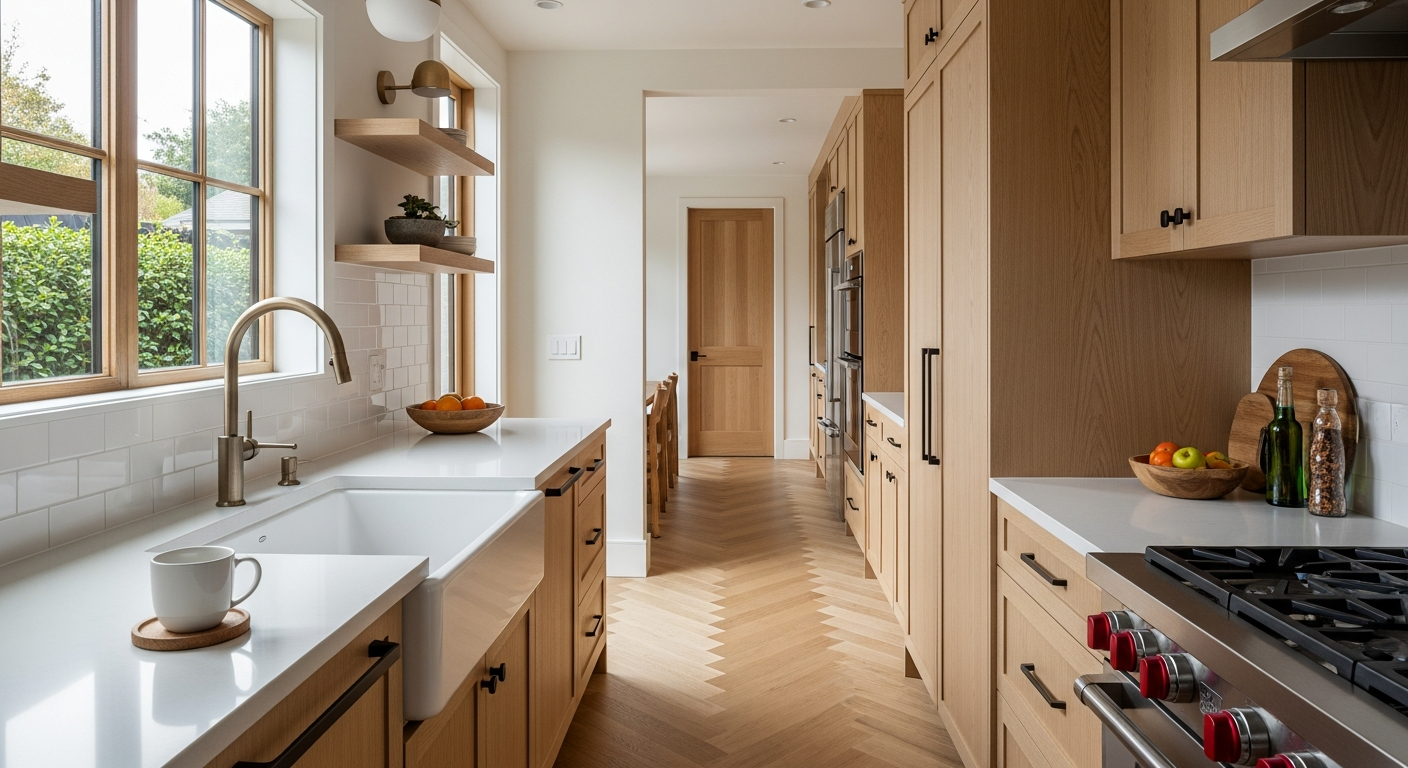
- Rift-cut white oak everything: Inside, rift-cut white oak is everywhere — flooring in herringbone or straight-lay patterns, kitchen cabinetry with integrated finger pulls (no visible hardware), and even ceiling details. It delivers that warm Scandinavian-California hybrid that Palo Alto homeowners love.
- Microcement and hand-applied plaster walls: Instead of standard drywall-and-paint, we're seeing a surge in microcement feature walls and hand-applied plaster (Venetian or lime-wash finishes) that add depth, texture, and visual warmth to compact ADU spaces. These finishes make a 600 sq ft studio feel like a boutique hotel rather than a rental unit.
- Dekton and quartzite countertops: Dekton Kreta and Dekton Lunar have overtaken traditional quartz for ADU kitchens — they're virtually indestructible, come in larger slab sizes (reducing seams), and offer the organic, stone-like aesthetic that pairs perfectly with warm cabinetry. For higher budgets, Calacatta Viola marble remains stunning but requires homeowner buy-in on maintenance.
- Induction cooktops: Palo Alto's reach codes effectively require all-electric new construction, making induction cooktops from brands like Miele and Bosch standard in every ADU we build. Performance has caught up to gas — most clients prefer them after the first week of cooking.
- Fluted details: Fluted wood panels on kitchen islands, bathroom vanities, and built-in storage add dimension and visual interest to small spaces without overwhelming them.
- Zellige tile: Handmade zellige tile in ADU bathrooms and kitchen backsplashes — in warm earth tones like terracotta, sage, and cream — brings artisanal character that mass-produced subway tile simply can't match.
- Unlacquered brass hardware and fixtures: Unlacquered brass faucets and cabinet pulls from brands like Waterworks and Kohler develop a living patina that reinforces the warm, organic palette.
From a layout perspective, the smartest Palo Alto ADUs in 2026 prioritize indoor-outdoor flow. We're designing ADUs with oversized sliding glass walls (often Fleetwood or Western Window Systems) that open to a private patio, effectively doubling the usable living space. Combined with thoughtful landscaping and hardscape design, even a compact backyard ADU feels expansive.
Our 3D design and rendering service lets Palo Alto homeowners see exactly how their ADU will look — materials, lighting, and spatial flow — before construction begins. This is particularly valuable for ADUs because every square foot matters, and design mistakes in small spaces are magnified.
Is an ADU in Palo Alto a Good Investment in 2026?
Yes — an ADU in Palo Alto is one of the strongest real estate investments available to Bay Area homeowners in 2026, offering rental income potential of $3,200–$5,500+ per month while adding an estimated $250,000–$500,000+ in property value. The combination of Palo Alto's extreme housing demand, proximity to Stanford University and Silicon Valley tech employers, and California's favorable ADU legislation creates ideal investment conditions.
Let me break down the math with real numbers from our 2026 Palo Alto projects:
- Construction cost for a 750 sq ft one-bedroom detached ADU: approximately $375,000–$425,000 fully permitted and finished.
- Monthly rental income: $3,800–$4,800/month for a one-bedroom ADU in Palo Alto, based on current Zillow and Craigslist rental data. Furnished units near Stanford or California Avenue command premiums of 20–30%.
- Annual gross rental income: $45,600–$57,600.
- Estimated property value increase: $300,000–$450,000, based on comparable ADU-equipped sales in Palo Alto and Los Altos in 2024–2025.
- Simple payback period through rental income: 7–9 years, not accounting for the immediate property value increase.
The property value math is particularly compelling. A Palo Alto home that sells for $3.5 million without an ADU might sell for $3.85–$4.0 million with a well-built, permitted ADU — and you've only spent $400,000 to build it. That's immediate equity creation.
Under AB 1033, which took effect in 2024, cities can now allow ADUs to be sold separately from the main house as condominiums. While Palo Alto hasn't opted into this provision yet as of early 2026, the legislative trajectory suggests this could become available in coming years — potentially making your ADU a sellable independent unit worth $800,000+ in this market.
Beyond pure investment returns, our clients in Palo Alto, Los Altos, and Menlo Park build ADUs for multi-generational living (aging parents, adult children returning to the Bay Area), home office studios, and guest housing. These lifestyle benefits don't show up in a spreadsheet but are often the primary motivation — the rental income is a bonus.
Palo Alto ADU Permit Process: Step-by-Step for 2026
The Palo Alto ADU permit process in 2026 involves six key steps and typically takes 10–20 weeks from application to building permit issuance, depending on the complexity of your project and the completeness of your initial submittal. Here's exactly how the process works, based on our direct experience filing permits with Palo Alto's Development Services department.
Step 1: Feasibility Assessment (Week 1–2)
Before investing in design, verify your lot's buildability. Check setbacks, existing lot coverage, utility locations, tree protection zones (Palo Alto's tree ordinance is strict), and sewer/water lateral capacity. Our team performs this analysis before we draft a single line — it saves clients thousands in aborted design work.
Step 2: Design & Engineering (Weeks 2–12)
Develop complete architectural plans, structural engineering, Title 24 energy calculations, and a site plan. For Palo Alto, you'll also need a grading and drainage plan, a tree protection plan if there are any protected trees within 25 feet of the build area, and a green building checklist. If your lot is in a flood zone (parts of south Palo Alto near San Francisquito Creek), you'll need elevation certificates and flood-proofing details.
Step 3: Permit Application Submittal
Submit your complete plan set to Palo Alto's Development Services at City Hall or through their online portal. Include the planning application, building permit application, and all required engineering documents. Permit fees for ADUs in Palo Alto currently run $12,000–$25,000 depending on unit size and utility impact fees.
Step 4: Plan Review (Weeks 12–22)
Your plans go through concurrent review by Planning, Building, Fire, Public Works, and Utilities. State law requires the city to act on ADU applications within 60 days of a complete submittal. In practice, Palo Alto meets this timeline for straightforward projects. Complex sites — steep slopes, heritage trees, flood zones — may trigger additional review.
Step 5: Corrections & Permit Issuance
Address any plan check corrections (most projects have at least one round), resubmit, and receive your building permit. This correction cycle typically adds 2–4 weeks.
Step 6: Construction & Inspections
Once the permit is issued, construction begins. Palo Alto requires inspections at foundation, framing, rough mechanical/electrical/plumbing, insulation, and final stages. Our team coordinates all inspections to minimize delays.
One important note: Palo Alto charges significantly lower permit fees for ADUs than for standard home additions, thanks to state mandates that cap impact fees for units under 750 sq ft. If your ADU is under 750 sq ft, you may be exempt from most impact fees entirely — a savings of $10,000–$30,000 compared to a few years ago.
ADU vs. Home Addition vs. Garage Conversion: Which Is Right for Your Palo Alto Property?
Choosing between a detached ADU, attached home addition, or garage conversion depends on your lot size, budget, goals, and how you plan to use the space. Each option has distinct advantages in the Palo Alto market, and the "right" choice varies dramatically from property to property.
| Feature | Detached ADU | Attached Home Addition | Garage Conversion |
|---|---|---|---|
| Typical Cost (2026) | $310K–$550K+ | $250K–$500K+ | $175K–$310K |
| Privacy Level | Highest | Moderate | Moderate to High |
| Rental Income Potential | Highest ($3,200–$5,500/mo) | Lower (shared-wall concerns) | Moderate ($2,800–$4,200/mo) |
| Property Value Impact | Strongest | Strong | Moderate |
| Permit Complexity | Moderate | Higher (modifies main house) | Lowest |
| Timeline | 8–14 months | 7–14 months | 5–9 months |
| Parking Impact | None (if transit-adjacent) | None | Lose garage parking |
| Best For | Rental income, multigenerational living | Expanding primary home | Budget-conscious, fast timeline |
In my experience building across the Bay Area, detached ADUs deliver the best ROI in Palo Alto because buyers and renters place a premium on privacy and separation. A well-designed detached ADU with its own entrance, outdoor space, and full kitchen commands significantly higher rent than an attached in-law suite.
Garage conversions make sense when budget is the primary constraint or when the existing garage structure is sound and well-positioned on the lot. However, many Palo Alto homeowners underestimate the cost of bringing a 1950s-era garage up to habitable standards — you're often adding foundation reinforcement, full insulation, plumbing, HVAC, and significant structural work. I tell clients: if the conversion cost exceeds 60% of a new-build ADU cost, it usually makes more financial sense to demolish and build new.
An attached home addition through our ADU and home addition service is ideal when you want to expand your primary living space rather than create a separate unit. This is common in Palo Alto's Eichler neighborhoods (Green Gables, Greenmeadow) where homeowners want to add bedrooms or a family room while maintaining the mid-century design language.
For homeowners who want to maximize their property's potential, building a detached ADU plus a JADU is now legally permitted on single-family lots — meaning you could have three income-producing units (main house, ADU, JADU) on one parcel. Our team has completed several of these dual-unit projects across Saratoga and Los Gatos and is now seeing strong demand in Palo Alto.
Frequently Asked Questions
How much does it cost to build an ADU in Palo Alto California in 2026?
A new detached ADU in Palo Alto costs $310,000–$550,000+ in 2026, with the average cost per square foot ranging from $450 to $700. Garage conversions are more affordable at $175,000–$310,000, and JADUs (junior ADUs within your existing home) cost $95,000–$195,000. Based on our 116+ completed Bay Area projects, the average Palo Alto homeowner spends approximately $400,000 for a well-finished 750 sq ft one-bedroom detached ADU including all permits, design, engineering, and construction.
What is the maximum ADU size allowed in Palo Alto?
Under California state law, which overrides local restrictions, Palo Alto allows detached ADUs up to 1,200 square feet for two-bedroom units, 1,000 square feet for one-bedroom units, and 850 square feet for studios. Junior ADUs (JADUs) are limited to 500 square feet. The state also mandates that cities allow at least an 800 sq ft ADU regardless of existing lot coverage or FAR limits, which is particularly beneficial on smaller Palo Alto lots.
How long does it take to get an ADU permit approved in Palo Alto?
Permit approval for an ADU in Palo Alto takes 8–18 weeks from application submittal in 2026, depending on the completeness of your plans and the complexity of your project. State law requires cities to act within 60 days of receiving a complete application. However, the design and engineering phase before submittal takes an additional 8–16 weeks. Our total timeline from initial consultation to building permit issuance averages 16–24 weeks for Palo Alto projects.
Do I need to live on the property to build an ADU in Palo Alto?
No. As of January 1, 2025, California law (AB 976) permanently eliminated owner-occupancy requirements for ADUs. You do not need to live in either the main house or the ADU in Palo Alto. This applies to all new ADU permits and means you can rent out both the primary residence and the ADU simultaneously, making ADUs a more attractive investment for property owners.
Can I build a two-story ADU in Palo Alto in 2026?
Yes, but with height restrictions. Detached ADUs in Palo Alto can be up to 16 feet tall, or up to 18 feet if located within one-half mile of a major transit stop (which includes much of Palo Alto near Caltrain stations and VTA routes). Two-story attached ADUs can reach 25 feet in certain zones. A two-story detached ADU at 16–18 feet is achievable but requires careful architectural design to fit a functional second floor — typically a lofted bedroom — within the height envelope.
How much rent can I charge for an ADU in Palo Alto?
ADUs in Palo Alto rent for $3,200–$5,500+ per month in 2026, depending on size, finishes, and location within the city. A well-finished one-bedroom, one-bathroom ADU of 600–800 sq ft typically rents for $3,800–$4,800/month. Furnished units near Stanford University or downtown California Avenue command 20–30% premiums. Studios rent for $2,800–$3,500/month. These rates make Palo Alto one of the strongest ADU rental markets in the entire Bay Area.
What are the permit fees for building an ADU in Palo Alto?
Permit and impact fees for ADUs in Palo Alto range from $12,000 to $25,000 in 2026, depending on unit size. Under California state law, ADUs under 750 sq ft are exempt from most development impact fees, which can save $10,000–$30,000 compared to standard construction. Fees include plan check fees, building permit fees, utility connection fees (water, sewer, electrical), and school district fees. The city publishes its current fee schedule on the Palo Alto Development Services website.
Can I build an ADU and a JADU on the same lot in Palo Alto?
Yes. California state law allows homeowners to build both one ADU (up to 1,200 sq ft) and one junior ADU (up to 500 sq ft) on a single-family lot. The JADU must be created within the existing footprint of the primary home — typically by converting a bedroom, attached garage, or other existing space. This dual-unit strategy can generate $6,000–$9,000+ per month in combined rental income in Palo Alto, though it requires careful planning to meet building code requirements for both units.