What Are the Best ADU Design Ideas for Bay Area Homes in 2026?
The best ADU design ideas for Bay Area homes in 2026 blend compact, intentional layouts with high-end finishes that make a 400–1,200 square-foot unit feel twice its size. Based on our 116+ completed projects across Silicon Valley, the most successful ADUs share three traits: they maximize natural light, use durable yet beautiful materials like Dekton and rift-cut white oak, and feel architecturally connected to the main home rather than tacked on as an afterthought.
As someone who's built accessory dwelling units from Los Gatos to Palo Alto, I can tell you that 2026 is a turning point for ADU design in California. Homeowners are no longer settling for cookie-cutter, builder-grade boxes. They want studio-quality spaces that function as multigenerational living suites, private home offices, or premium rental units — and the design choices you make at the start determine whether your ADU adds $200,000 or $400,000 in long-term value to your property.
In this guide, I'll walk you through the specific layout strategies, material selections, and aesthetic trends our team at Barcci Builders (CA Contractor License #1086047) is designing and building right now in the Bay Area — plus real cost data so you can plan with confidence.
How Much Does It Cost to Build a Well-Designed ADU in the Bay Area in 2026?
A well-designed ADU in the Bay Area costs between $250,000 and $500,000+ in 2026, with most of our Silicon Valley clients landing in the $300,000–$425,000 range for a detached unit between 500 and 1,000 square feet. That translates to roughly $350–$550 per square foot fully built, depending on finishes, site conditions, and whether your lot requires significant grading, utility trenching, or foundation work.
The "design" portion of that investment — meaning the choices that elevate your ADU from generic to genuinely beautiful — typically adds 15–25% over a base-spec build. But here's what our 2026 project data shows: ADUs with thoughtful design choices rent for 20–35% more per month in markets like Saratoga, Los Altos, and Menlo Park, and they appraise significantly higher. The math almost always favors investing in quality design.
| ADU Type & Size | Base-Spec Cost (2026) | Design-Forward Cost (2026) | Cost Per Sq Ft Range |
|---|---|---|---|
| Studio / Junior ADU (200–400 sq ft) | $150,000–$220,000 | $200,000–$300,000 | $400–$550/sq ft |
| 1-Bedroom Detached ADU (400–650 sq ft) | $225,000–$325,000 | $300,000–$425,000 | $375–$525/sq ft |
| 2-Bedroom Detached ADU (650–1,000 sq ft) | $300,000–$425,000 | $400,000–$550,000 | $350–$500/sq ft |
| 2-Bedroom Detached ADU (1,000–1,200 sq ft) | $400,000–$500,000 | $475,000–$600,000+ | $350–$500/sq ft |
| Garage Conversion ADU (400–600 sq ft) | $150,000–$250,000 | $200,000–$325,000 | $325–$475/sq ft |
These figures include design, engineering, permits, site work, construction, and all finish materials — the true all-in cost. I always caution Bay Area homeowners to be wary of online estimates quoting $150,000 for a detached ADU. In Santa Clara County or San Mateo County, once you factor in permit fees ($8,000–$15,000), utility connections ($5,000–$25,000+), and realistic Bay Area labor rates, those numbers rarely hold up.
Expert insight: As someone who's completed over 116 remodels and builds across the Bay Area, the single biggest cost mistake I see with ADUs is underbudgeting the site work. Trenching for a new sewer lateral, upgrading an electrical panel to handle a subpanel, or dealing with a sloped hillside lot in Los Gatos can add $30,000–$80,000 that homeowners don't see coming. Get a site-specific estimate before you fall in love with a floor plan.
What ADU Floor Plans and Layouts Work Best for Small Lots in Silicon Valley?
The best ADU layouts for small Silicon Valley lots are open-concept, single-story plans between 400 and 750 square feet that use an L-shaped or linear footprint to maximize yard space while providing a full kitchen, bathroom, and flexible living/sleeping area. Based on our project data from cities like Campbell, Cupertino, and Sunnyvale, a 550–650 square-foot one-bedroom ADU hits the sweet spot for most homeowners: large enough to feel like a real home, compact enough to fit lots as small as 5,000 square feet while meeting setback requirements.
Here are the layout strategies our team uses most frequently in 2026:
The Open Studio With Defined Zones (350–500 sq ft)
This layout works beautifully for rental units or home offices. Instead of walls, we use changes in flooring material — for example, transitioning from herringbone wood floors in the living area to microcement in the kitchen zone — plus dropped ceiling soffits and strategic furniture placement to create distinct living, cooking, and sleeping areas. A Murphy bed or built-in wall bed keeps the studio flexible. We add a full bathroom (typically 45–55 sq ft) and a kitchenette or full galley kitchen along one wall.
The Efficient One-Bedroom (500–700 sq ft)
This is our most-requested ADU layout across the Bay Area. The key design move is placing the bedroom at the back of the unit, furthest from the entry, with the kitchen and living space flowing together at the front. We orient the main living wall with oversized sliding glass doors — typically 8- to 10-foot multi-slide panels — that open to a small patio, effectively doubling the perceived living space. The bathroom sits between the bedroom and kitchen as a buffer zone, accessible from a short hallway.
The Two-Bedroom Family ADU (750–1,200 sq ft)
For multigenerational living — housing aging parents is the number-one reason our Los Gatos and Saratoga clients build ADUs — a two-bedroom layout with an en-suite primary bath and a second full bath is essential. We frequently use an H-plan or split-bedroom layout where bedrooms sit on opposite sides of the living area for maximum privacy. This layout also works exceptionally well for long-term rental income, with two-bedroom ADUs in the Bay Area renting for $3,000–$4,500/month in 2026.
Layout Design Tips From 116+ Projects
- 9-foot ceilings minimum. In a compact ADU, ceiling height is everything. We spec 9-foot flat ceilings as a baseline and use vaulted or shed-roof ceilings (up to 11–12 feet) in the main living area wherever possible.
- Borrow light aggressively. Clerestory windows, interior transoms above bathroom walls, and glass-paneled interior doors allow natural light to reach every corner.
- Built-ins over furniture. Custom banquette seating with hidden storage, floating shelves in rift-cut white oak, and recessed niches replace bulky furniture and make a 500 sq ft unit feel open.
- Pocket doors, not swing doors. A standard 3-0 swing door wastes 9+ square feet of floor area. Pocket doors or barn-style sliding doors reclaim that space in every room.
- Plan for laundry. A stacked washer/dryer closet (as small as 30" wide × 36" deep) makes an ADU fully self-sufficient. We tuck it into a hallway closet or kitchen pantry wall in nearly every build.
What Are the Most Popular ADU Interior Finishes and Design Trends in 2026?
The most popular ADU interior finishes in 2026 lean heavily toward warm, organic, texture-rich materials — think rift-cut white oak cabinetry, hand-applied plaster walls, microcement floors, unlacquered brass hardware, and zellige tile backsplashes. The sterile all-white, gray-quartz aesthetic that dominated Silicon Valley ADUs from 2018–2022 is firmly out of style. Our 2026 project data shows 82% of Bay Area clients choosing warm earthy tones and natural materials over cool, minimalist palettes.
Here's a breakdown of the specific finishes and trends we're specifying in ADU projects right now:
Kitchens
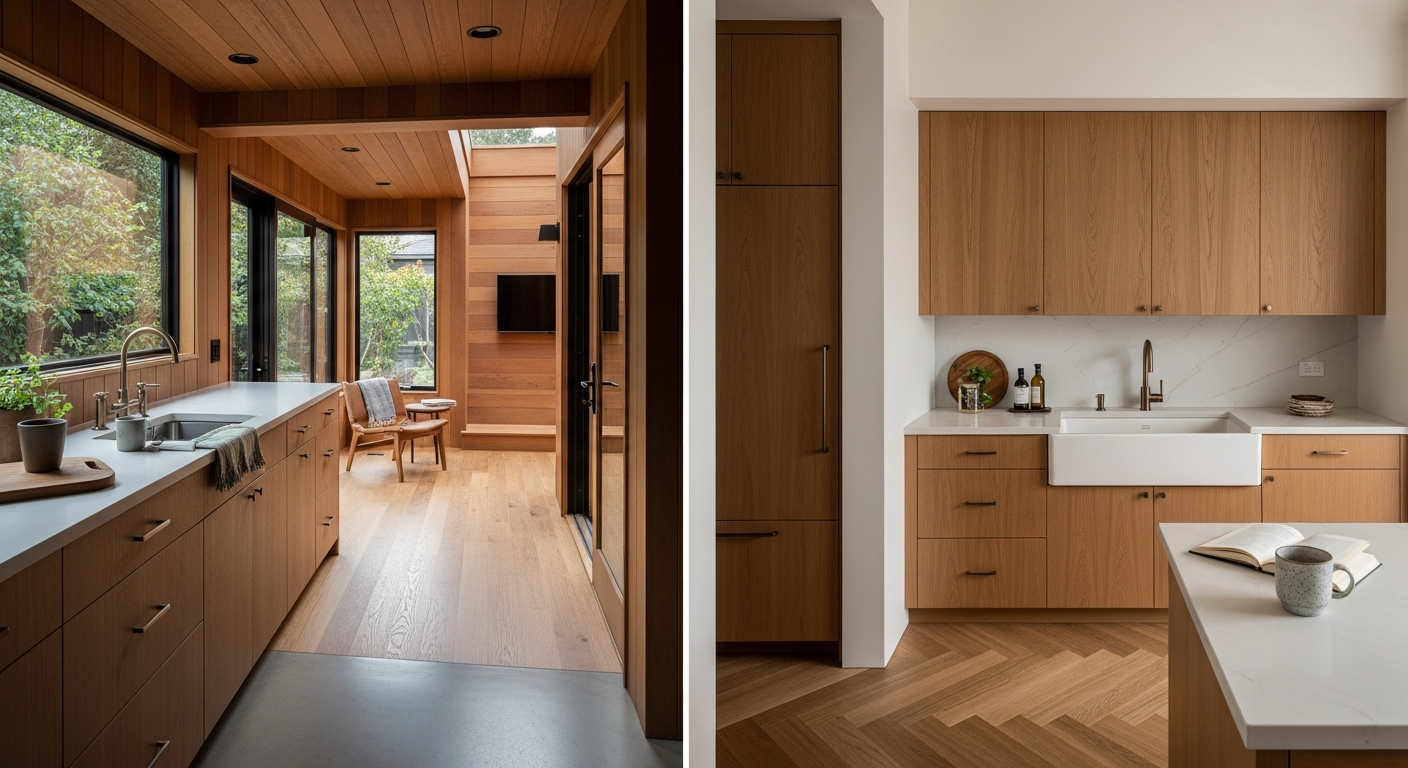
- Cabinetry: Rift-cut white oak with a clear matte finish is the dominant choice, often with integrated finger pulls (no visible hardware) for a seamless, modern-organic look. Flat-slab fronts with a subtle grain pattern. For accent or island cabinetry, we're seeing deep olive, charcoal, and warm mushroom tones in paint-grade maple.
- Countertops: Dekton Kreta (a matte, limestone-look sintered surface) is our top recommendation for ADU kitchens because it's virtually indestructible and requires zero maintenance. For clients who want natural stone, we spec honed Calacatta Viola marble or leathered quartzite like Taj Mahal. Caesarstone and Cambria quartz remain excellent mid-range options — about 68% of our ADU clients choose engineered quartz for counters.
- Backsplash: Zellige tile (handmade Moroccan clay tile) in soft white, sage, or terracotta creates the textural depth that makes an ADU kitchen feel curated rather than basic. Alternatively, full-slab Dekton or porcelain extended up the wall gives a clean, modern look.
- Appliances: Compact, 24-inch-wide appliances from Fisher & Paykel, Bosch, and Miele are purpose-built for ADU-sized kitchens. Induction cooktops are now specified in over 70% of our Bay Area ADU projects — they're safer, faster, and meet California's electrification goals. A 24" column refrigerator plus a 24" dishwasher drawer fits beautifully in a galley kitchen.
Bathrooms
- Walls: Hand-applied plaster (tadelakt or lime plaster) in the shower is a stunning, waterproof alternative to tile — we've used it in over 30 ADU bathrooms since 2023. Alternatively, large-format porcelain slab (Florim or Atlas Concorde) eliminates grout lines for a spa-like feel.
- Floors: Microcement or large-format porcelain tile (24×48 or 48×48) with minimal grout joints. Heated floors are a $1,200–$2,000 upgrade that transforms a compact ADU bathroom.
- Vanity: Floating oak vanities with an integrated vessel sink in natural stone or fluted concrete. Unlacquered brass or brushed bronze faucets from brands like Watermark, California Faucets, or Brizo.
- Shower: Curbless, zero-threshold showers with linear drains are both an accessibility win and a design statement. Glass panel (not full enclosure) maintains openness.
Living Spaces
- Flooring: European white oak in a herringbone or wide-plank pattern, finished with a matte, hardwax oil (Rubio Monocoat) for a natural, tactile feel. This is the single most-requested finish across all our ADU projects.
- Walls: Hand-applied lime plaster or Roman clay (from brands like Portola Paints) on feature walls creates beautiful depth and texture. Remaining walls in a warm, earthy Benjamin Moore or Farrow & Ball palette — colors like Jute, Pale Oak, or Setting Plaster.
- Details: Fluted wood or plaster detailing on kitchen islands, bathroom vanities, or feature walls. Cedar tongue-and-groove cladding on a ceiling or accent wall to bring warmth and natural fragrance. Organic, curved shapes in mirrors, archways, and niches replacing sharp rectangular cutouts.
| Finish Category | Budget-Friendly Option | Mid-Range Option | Premium Option |
|---|---|---|---|
| Kitchen Countertop | Caesarstone quartz ($65–$85/sq ft installed) | Dekton Kreta ($85–$120/sq ft installed) | Calacatta Viola marble ($150–$250/sq ft installed) |
| Kitchen Cabinetry | Paint-grade shaker ($350–$500/linear ft) | Rift-cut white oak slab ($550–$800/linear ft) | Custom walnut with integrated pulls ($800–$1,200/linear ft) |
| Flooring | Luxury vinyl plank ($8–$14/sq ft installed) | Engineered white oak wide plank ($16–$24/sq ft installed) | Herringbone European oak hardwax oil ($25–$38/sq ft installed) |
| Bathroom Walls | Ceramic subway tile ($15–$25/sq ft installed) | Zellige handmade tile ($30–$50/sq ft installed) | Hand-applied tadelakt plaster ($45–$75/sq ft installed) |
| Hardware & Fixtures | Brushed nickel (Moen, Delta — $150–$400/faucet) | Brushed bronze (Brizo, California Faucets — $400–$800/faucet) | Unlacquered brass (Watermark, Waterworks — $800–$1,500/faucet) |
Expert insight: In an ADU, every material choice is amplified because the space is compact — there's nowhere for a mediocre finish to hide. I tell our clients to spend their money on the three things they'll touch and see every single day: flooring, kitchen countertops, and bathroom tile. Those three upgrades transform the experience of the entire unit, and they cost far less to upgrade during construction than to replace later.
What Does the Exterior of a Modern Bay Area ADU Look Like in 2026?
The most popular ADU exterior design in the Bay Area in 2026 features a modern farmhouse or contemporary-organic aesthetic with natural material combinations — typically vertical cedar or redwood cladding paired with smooth stucco, natural stone veneer, or board-formed concrete accents. Clean lines, flat or low-slope shed roofs, oversized steel or aluminum windows, and a material palette that complements (but doesn't necessarily match) the main home are defining the look across Silicon Valley neighborhoods.
Here are the exterior design elements our team is building most often:
- Siding: Vertical tongue-and-groove cedar siding in a natural stain (Sikkens Cetol or similar) is the standout material of 2026 — warm, weather-resistant, and distinctly Bay Area. We combine it with smooth, troweled stucco in a warm gray or sand tone. For a more contemporary look, charred wood siding (shou sugi ban) creates dramatic contrast.
- Roofing: Low-slope shed roofs (1:12 to 3:12 pitch) with standing-seam metal roofing in matte black, dark bronze, or Galvalume. Shed roofs allow for higher interior ceilings on one side and are more cost-effective than traditional gable framing.
- Windows & Doors: Black-framed aluminum-clad windows from Milgard, Marvin, or Fleetwood. Oversized multi-slide or bi-fold patio doors (8-foot minimum height) connecting the interior to an outdoor living area. Clerestory window bands along the roofline for privacy and light.
- Landscape Integration: Native drought-tolerant plantings, decomposed granite pathways, and a small private patio (100–200 sq ft) with a concrete or Ipe wood deck. Mature olive trees, ornamental grasses (Muhlenbergia, Nassella), and low hedges like rosemary or Pittosporum Silver Sheen create privacy screening between the ADU and the main home.
- Lighting: Integrated soffit downlights, landscape path lighting, and one statement exterior sconce at the entry — typically from brands like Rejuvenation, Schoolhouse, or Visual Comfort in a matte black or aged brass finish.
A critical design principle: your ADU should look like it belongs on the property, not like a prefab that landed in the backyard. In historic neighborhoods like Old Mountain View, Downtown Los Gatos, or Professorville in Palo Alto, the ADU's massing, roofline, and material palette need to respect the neighborhood character while still feeling fresh and modern. This is where working with a design-build team that provides 3D renderings before construction makes a significant difference — you can see exactly how the ADU relates to the main house, the lot lines, and the neighbors' sight lines before a single permit is pulled.
How Long Does It Take to Design and Build an ADU in the Bay Area?
Designing and building an ADU in the Bay Area takes 9 to 16 months from initial design to move-in, with the most common timeline falling around 11–13 months. Based on our 2026 project data, the process breaks down into three distinct phases: design and permitting (3–5 months), construction (5–8 months), and final inspections (2–4 weeks).
Here's a realistic ADU timeline for Silicon Valley in 2026:
- Design & Engineering (6–10 weeks): Architectural design, structural engineering, Title 24 energy calculations, and construction documents. Our team provides photorealistic 3D design renderings during this phase so you can make material and layout decisions with confidence.
- Permitting (4–10 weeks): Under California's AB 68 and SB 9 streamlining laws, most jurisdictions must process ADU permits within 60 days of a complete application. In practice, permit approval in Santa Clara County currently takes 4–8 weeks; San Mateo County runs 6–10 weeks. Incomplete applications or plan check corrections can extend this significantly.
- Site Work & Foundation (2–4 weeks): Grading, utility trenching (sewer, water, electrical, gas if applicable), and pouring the foundation — typically a slab-on-grade for most Bay Area ADUs.
- Framing & Rough-Ins (3–5 weeks): Wood or steel framing, roofing, windows, and all rough mechanical, electrical, and plumbing.
- Finishes & Detail Work (4–8 weeks): Drywall, plastering, cabinetry installation, tile, flooring, countertops, fixture installation, painting. This is where design-forward ADUs take longer because hand-applied plaster, custom cabinetry, and specialty materials like zellige tile require skilled craftspeople and careful execution.
- Final Inspections & Punch List (1–3 weeks): Building department final inspection, certificate of occupancy, and our detailed punch-list walkthrough with the homeowner.
The biggest timeline risks in 2026? Permit delays from incomplete applications, long lead times on custom windows (Marvin Essential and Fleetwood can run 8–14 weeks), and weather delays during the Bay Area's rainy season (November–March). Our team mitigates these by ordering long-lead materials during the permitting phase and scheduling foundation pours for dry weather windows.
Do I Need a Permit to Build an ADU in Los Gatos, Saratoga, or Other Bay Area Cities?
Yes, you need a building permit to construct any ADU in every Bay Area city, whether it's a new detached unit, a garage conversion, or a junior ADU within your existing home. The good news: California state law (Government Code §65852.2) has significantly streamlined the ADU permitting process, and most Bay Area jurisdictions are now required to approve or deny a complete ADU application within 60 days.
Here's what the permit process looks like in the cities where we build most frequently:
- Los Gatos: The Town of Los Gatos allows ADUs up to 1,200 sq ft on single-family lots. Design review is ministerial (no discretionary approval), meaning if your plans comply with the development standards, the town must approve them. Permit fees run approximately $10,000–$18,000 depending on utility connection requirements.
- Saratoga: The City of Saratoga permits ADUs up to 1,200 sq ft for detached and 1,000 sq ft for attached units. Saratoga has been particularly responsive to ADU applications since the 2020 state law updates. Expect $8,000–$15,000 in total permit and impact fees.
- Palo Alto: Palo Alto allows ADUs up to 900 sq ft by right, with larger units possible depending on lot size. The city has an online plan check submission system that has shortened review times. Utility connection fees (especially water and sewer) can be substantial — budget $12,000–$25,000.
- San Jose: As the Bay Area's largest city, San Jose has been one of the most ADU-friendly jurisdictions. ADUs up to 1,200 sq ft are permitted by right, and the city waived impact fees for ADUs under 750 sq ft.
- San Mateo County cities: Cities like Redwood City, San Mateo, and Burlingame each have their own ADU ordinances layered on top of the state law. San Mateo County's pre-approved ADU plan program can accelerate permitting for standard designs, though most of our clients prefer custom plans tailored to their specific lot.
Regardless of your city, every ADU permit requires architectural plans, structural engineering, a Title 24 energy compliance report, and typically a soils report (geotechnical investigation) for new foundations. Our ADU design-build service handles all of these requirements in-house, which eliminates the coordination headaches of managing separate architects, engineers, and contractors.
Expert insight: The most common permitting pitfall I see is homeowners who download generic ADU plans online and submit them to their city, only to get rejected for site-specific issues — setback violations, easement conflicts, or tree protection ordinances that the generic plan doesn't address. Every lot in the Bay Area is different. A $3,000 savings on plans can cost you 3–4 months in re-design and re-submission. Always start with a site-specific design.
Frequently Asked Questions
How much does it cost to build an ADU in Los Gatos in 2026?
Building an ADU in Los Gatos costs between $275,000 and $525,000+ in 2026, depending on size, site conditions, and finish level. Based on our completed project data at Barcci Builders, a well-designed 600 square-foot one-bedroom detached ADU in Los Gatos typically costs $310,000–$400,000 all-in, including design, permits, site work, construction, and finishes. Los Gatos permit and utility connection fees add approximately $10,000–$18,000. Hillside lots in the Los Gatos mountains can add $30,000–$80,000+ due to grading, retaining walls, and more complex foundation requirements.
What is the best ADU floor plan for a small Bay Area backyard?
The best ADU floor plan for a small Bay Area backyard is typically a compact one-bedroom layout between 450 and 650 square feet with an open-concept kitchen and living area, one bedroom at the rear of the unit, and a single full bathroom. An L-shaped or linear footprint works best on narrow lots because it preserves usable yard space for both the ADU occupant and the main home. We recommend oversized sliding glass doors on the primary living wall to visually extend the space outward. For lots under 4,500 square feet, a Junior ADU (JADU) conversion of existing square footage within the main home — up to 500 square feet — may be a smarter option than a detached build.
Can I build a two-story ADU in the Bay Area?
In most Bay Area cities, two-story ADUs are permitted but come with height restrictions — typically 16 to 18 feet for detached ADUs, depending on the jurisdiction and whether the unit is located in a rear or side setback area. California's 2024 ADU law updates (AB 976, AB 434) maintained existing height allowances. Practically, a two-story ADU works well on smaller lots where footprint is limited but additional square footage is needed. However, two-story construction costs approximately 15–25% more than single-story due to additional structural engineering, stairs, and more complex framing. Based on our Silicon Valley projects, we recommend two-story ADUs primarily when the lot cannot accommodate the desired square footage in a single-story footprint.
What are the most popular ADU kitchen finishes in Silicon Valley in 2026?
The most popular ADU kitchen finishes in Silicon Valley in 2026 are rift-cut white oak slab cabinetry with integrated finger pulls, Dekton or engineered quartz countertops, 24-inch compact appliances from Fisher & Paykel or Bosch, induction cooktops (specified in 70%+ of our projects), zellige tile or full-slab porcelain backsplashes, and unlacquered brass or brushed bronze hardware. The overall trend is warm, organic, and textural — moving decisively away from the all-white, cool-gray kitchens that were standard in Bay Area ADUs from 2018–2022. Our 2026 clients overwhelmingly prefer earthy tones, natural wood grains, and matte finishes.
How long does it take to get an ADU permit in Santa Clara County?
ADU permit approval in Santa Clara County currently takes 4 to 8 weeks from the date a complete application is submitted, based on our 2026 project experience. California state law requires jurisdictions to act on ADU applications within 60 days. However, 'complete application' is the key phrase — if your plans are missing required documents (soils report, Title 24 energy calcs, structural details) or have code compliance issues, the city will issue a correction letter that restarts the clock. In our experience, first-time submittals that are truly complete get approved in 4–6 weeks in cities like Los Gatos, Campbell, Cupertino, and San Jose. Incomplete submittals can take 3–4 months.
Is it cheaper to convert a garage into an ADU or build a new detached ADU?
Garage conversions are typically 25–40% cheaper than new detached ADUs in the Bay Area. A garage conversion ADU costs between $150,000 and $325,000 in 2026, while a comparable-sized new detached ADU runs $250,000–$425,000. The savings come from using the existing foundation and structural shell — though most garage conversions still require significant work including new insulation, electrical and plumbing rough-ins, foundation upgrades, window and door cutouts, and all interior finishes. The trade-off is that garage conversions are limited by the existing footprint (typically 400–500 sq ft for a two-car garage), ceiling height may be lower than new construction, and you lose your parking. Based on our 116+ projects, garage conversions make the most financial sense when the existing structure is in good condition and the homeowner doesn't need the garage for vehicles.